
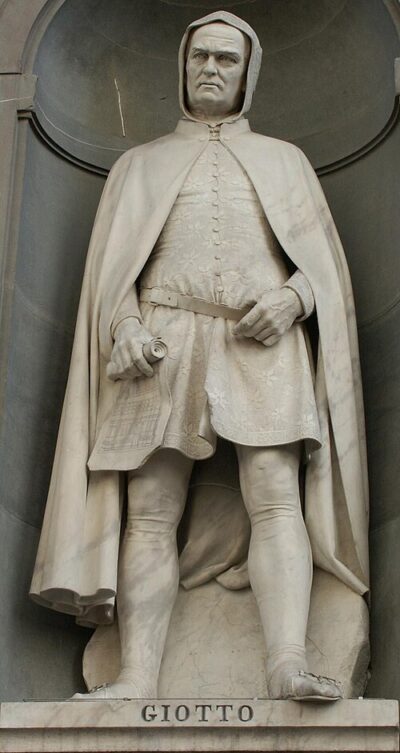
Giotto
Giotto was an Italian painter and architect (c. 1267–1337). Born 1267, in Vicchio. Died January 8, 1337, in Florence. Positions held include court painter. Known for Scrovegni Chapel, Saint Stephen and Giotto's Campanile.
Facts
27 facts · 2 confirmed by two sources · 13 cited · 12 from one source
What’s different
- Born: we show 1267 (Confirmed). Wikidata also lists 1276
Where this comes from
Papalocal keeps its own record. It started from these sources; what each one said is kept here as it was copied, so a change on their side never changes this page by itself. Tap one to read its version.
What Wikidata says · copied November 16, 2026 · revision 2569911587
- Described as
- Italian painter and architect (c. 1267–1337)
- Other names
- Ambrogio di Bondone Giotto, Giotto Di Bondone, Ambrogio Bondone, Giottè, Giott`e, di Bondone Giotto, Dzhotto di Bondone, Ambrogio di Bondone, Giotto de Bondone, Le Giotto, Giotto da Vespignano, Giotti
- Born
- 1267 · 2 references; 1276
- Died
- January 8, 1337 · 2 references
- Born in
- Vicchio · 3 references
- Died in
- Florence · 4 references
- Buried in
- Florence Cathedral · 1 reference
- Citizen of
- Republic of Florence
- Occupation
- painter · 5 references; architect · 3 references; sculptor · 2 references; muralist · 1 reference; designer · 1 reference; master builder · 1 reference; artist · 1 reference
- Positions held
- court painter
- Genre
- religious art · 1 reference; allegory · 1 reference; mythological painting · 1 reference
- Known for
- Scrovegni Chapel; Saint Stephen; Giotto's Campanile; Giotto's O; Virgin Mourning · 1 reference; Fragment of the Navicella Mosaic · 1 reference; Portrait of Dante · 1 reference
- Field
- architecture; painting
- Father
- Bondone
- Wikipedias with a page
- 99
Wikidata item Q7814 (wikidata.org/wiki/Q7814), public domain (CC0). Copied November 16, 2026.
What Wikipedia says · copied November 16, 2026 · revision 1376363402
Giotto di Bondone (Italian: [ˈdʒɔtto di bonˈdoːne]; c. 1267 – January 8, 1337), known mononymously as Giotto, was an Italian painter and architect from Florence during the Late Middle Ages. He worked during the Gothic and Proto-Renaissance period. Giotto's contemporary, the banker and chronicler Giovanni Villani, wrote that Giotto was "the most sovereign master of painting in his time, who drew all his figures and their postures according to nature" and of his publicly recognized "talent and excellence". Giorgio Vasari described Giotto as making a decisive break from the prevalent Byzantine style and as initiating "the great art of painting as we know it today, introducing the technique of drawing accurately from life, which had been neglected for more than two hundred years".
Giotto's masterwork is the decoration of the Scrovegni Chapel, in Padua, also known as the Arena Chapel, which was completed around 1305. The fresco cycle depicts the Life of the Virgin and the Life of Christ. It is regarded as one of the supreme masterpieces of the Early Renaissance.
The fact that Giotto painted the Arena Chapel and that he was chosen by the Commune of Florence in 1334 to design the new campanile (bell tower) of the Florence Cathedral are among the few certainties about his life. Almost every other aspect of it is subject to controversy: his birth date, his birthplace, his appearance, his apprenticeship, the order in which he created his works, whether he painted the famous frescoes in the Upper Basilica of Saint Francis in Assisi, and his burial place.
- Born, in its opening lines
- c. 1267
- Died, in its opening lines
- January 8, 1337
From the Wikipedia article “Giotto” (en.wikipedia.org/wiki/Giotto), by its contributors, under CC BY-SA 4.0 (creativecommons.org/licenses/by-sa/4.0/). Copied November 16, 2026; not changed.
Confirmed Two sources agree. Cited One source, and it names where it got it. One source One source, without a reference of its own. Sources disagree The sources disagree. We show the best-supported value and keep theirs below.
