
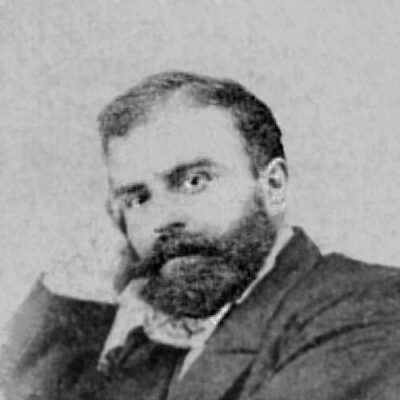
Giovanni Battista Donati
Giovanni Battista Donati was an Italian astronomer. Born December 16, 1826, in Pisa. Died September 20, 1873, in Florence. Educated at University of Pisa and Scuola Normale Superiore. Classe di Scienze. Awards include Lalande Prize.
Facts
13 facts · 2 confirmed by two sources · 5 cited · 6 from one source
What’s different
- Died: we show September 20, 1873 (Confirmed). Wikidata also lists September 19, 1873
Where this comes from
Papalocal keeps its own record. It started from these sources; what each one said is kept here as it was copied, so a change on their side never changes this page by itself. Tap one to read its version.
What Wikidata says · copied November 16, 2026 · revision 2557895883
- Described as
- Italian astronomer (1826–1873)
- Other names
- Giovan Battista Donati, Giambattista Donati
- Born
- December 16, 1826 · 3 references
- Died
- September 20, 1873 · 3 references; September 19, 1873 · 2 references
- Born in
- Pisa · 3 references
- Died in
- Florence · 3 references
- Cause of death
- cholera · 1 reference
- Citizen of
- Kingdom of Italy (1861–)
- Occupation
- astronomer · 2 references
- Education
- University of Pisa; Scuola Normale Superiore. Classe di Scienze (–1851) · 1 reference
- Member of
- Accademia Nazionale delle Scienze detta dei XL; Pontificia Accademia dei Nuovi Lincei (1858–) · 1 reference; Accademia Nazionale dei Lincei (1870–) · 1 reference
- Awards
- Lalande Prize (1858)
- Wikipedias with a page
- 29
Wikidata item Q455834 (wikidata.org/wiki/Q455834), public domain (CC0). Copied November 16, 2026.
What Wikipedia says · copied November 16, 2026 · revision 1372000105
Giovanni Battista Donati (Italian pronunciation: [dʒoˈvanni batˈtista doˈnaːti]; 16 December 1826 – 20 September 1873) was an Italian astronomer.
Donati graduated from the university of his native city, Pisa, and afterwards joined the staff of the Observatory of Florence in 1852. He was appointed director in 1864.
Donati was also a pioneer in the spectroscopic study of the stars, the Sun, and comets. He observed the total solar eclipse of 18 July 1860, at Torreblanca in Spain, and in the same year began experiments in stellar spectroscopy. In 1862 he published a memoir, Intorno alle strie degli spettri stellari, which indicated the feasibility of a physical classification of the stars.
Donati also used spectroscopy of comets to determine their physical composition, in particular with the comet 1864b, which spectrum he found containing three emitting lines which would four years later be identified by William Huggins to be carbon. He discovered that the spectrum changed when a comet approached the Sun, and that heating caused it to emit its own light rather than reflected sunlight: he concluded that the composition of comets is, at least in part, gaseous.
Between 1854 and 1864 he discovered six new comets, including the spectacular Comet Donati (C/1858 L1), found in 1858.
An investigation of the great aurora of 4 February 1872 led Donati to refer such phenomena to a distinct branch of science, designated by him "cosmical meteorology". However, he could not follow up on the subject, as he died from cholera, which he had contracted while attending a scientific convention in Vienna, the following year.
- Born, in its opening lines
- December 16, 1826
- Died, in its opening lines
- September 20, 1873
From the Wikipedia article “Giovanni Battista Donati” (en.wikipedia.org/wiki/Giovanni_Battista_Donati), by its contributors, under CC BY-SA 4.0 (creativecommons.org/licenses/by-sa/4.0/). Copied November 16, 2026; not changed.
Confirmed Two sources agree. Cited One source, and it names where it got it. One source One source, without a reference of its own. Sources disagree The sources disagree. We show the best-supported value and keep theirs below.
