
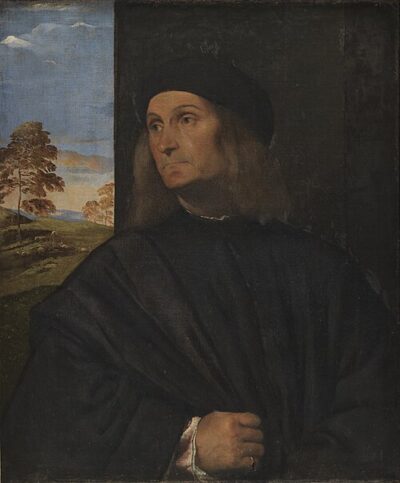
Giovanni Bellini
Giovanni Bellini was the 15th- and 16th-century Italian Renaissance painter. Born 1430, in Venice. Died November 29, 1516, in Venice. Known for Drunkenness of Noah, The Clemency of Scipio and Allegories.
Facts
32 facts · 1 confirmed by two sources · 16 cited · 14 from one source · 1 where the sources disagree
What’s different
- Died: we show November 29, 1516 (Sources disagree). Wikidata also lists November 26, 1516
Where this comes from
Papalocal keeps its own record. It started from these sources; what each one said is kept here as it was copied, so a change on their side never changes this page by itself. Tap one to read its version.
What Wikidata says · copied November 16, 2026 · revision 2569653053
- Described as
- 15th- and 16th-century Italian Renaissance painter (1430–1516)
- Other names
- Giovanni Bellein, Giovanni Bellinj, Giovanni Bellino, Ioannes Bellinus, Giovanni Bellin, Giovanni di Bellino, Jean Béllin, Jean Bellino, Jan de Bellini, Giouanni Bellino, John Bellini, Giovanni de Bellini
- Born
- 1430 · 3 references
- Died
- November 29, 1516 · 6 references; November 26, 1516 · 1 reference
- Born in
- Venice · 3 references
- Died in
- Venice · 3 references
- Buried in
- Santi Giovanni e Paolo
- Citizen of
- Republic of Venice
- Occupation
- painter · 4 references; illuminator · 1 reference; draftsperson · 2 references; architect · 1 reference; miniature painter · 1 reference; designer · 1 reference
- Genre
- history painting · 2 references; religious painting · 1 reference; allegory · 1 reference; animal painting · 1 reference; figure · 1 reference; genre painting · 1 reference
- Known for
- Drunkenness of Noah; The Clemency of Scipio; Allegories; Baptism of Christ · 1 reference; The Virgin and Child · 1 reference; Sacred conversation · 1 reference; Lamentation over the Dead Christ · 1 reference; Madonna with sleeping Child · 2 references; Madonna and Child with Saint John the Baptist and Saint Anne · 1 reference; Madonna with Blessing Child · 1 reference
- Field
- painting · 6 references
- Father
- Jacopo Bellini
- Siblings
- Gentile Bellini · 1 reference; Nicolosia Bellini
- Wikipedias with a page
- 73
Wikidata item Q17169 (wikidata.org/wiki/Q17169), public domain (CC0). Copied November 16, 2026.
What Wikipedia says · copied November 16, 2026 · revision 1383999135
Giovanni Bellini (Italian: [dʒoˈvanni belˈliːni]; Venetian: Zuane Belin ; c. 1430 – 29 December 1516) was an Italian Renaissance painter, probably the best known of the Bellini family of Venetian painters. He was raised in the household of Jacopo Bellini, formerly thought to have been his father, but now that familial generational relationship is questioned. An older brother or perhaps nephew, Gentile Bellini, was more highly regarded than Giovanni during his lifetime, but the reverse is true today. His brother-in-law was Andrea Mantegna.
Giovanni Bellini's use of clear, slow-drying oil paints had a great effect on the Venetian painting school, especially on his pupils Giorgione and Titian. The Bellini cocktail is named in his honour.
- Born, in its opening lines
- c. 1430
- Died, in its opening lines
- December 29, 1516
From the Wikipedia article “Giovanni Bellini” (en.wikipedia.org/wiki/Giovanni_Bellini), by its contributors, under CC BY-SA 4.0 (creativecommons.org/licenses/by-sa/4.0/). Copied November 16, 2026; not changed.
Confirmed Two sources agree. Cited One source, and it names where it got it. One source One source, without a reference of its own. Sources disagree The sources disagree. We show the best-supported value and keep theirs below.
