
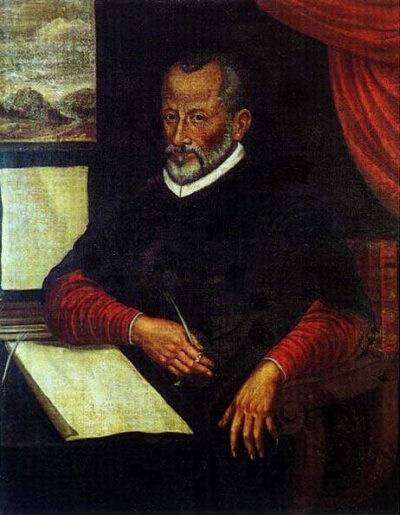
Giovanni Pierluigi da Palestrina
Giovanni Pierluigi da Palestrina was an Italian Renaissance composer (c. 1525–1594). Born 1525, in Palestrina. Died February 2, 1594, in Rome. Positions held include chapelmaster (1561–).
Facts
23 facts · 1 confirmed by two sources · 7 cited · 14 from one source · 1 where the sources disagree
What’s different
- Died: we show February 2, 1594 (Sources disagree). Wikipedia says February 2, 1526
Where this comes from
Papalocal keeps its own record. It started from these sources; what each one said is kept here as it was copied, so a change on their side never changes this page by itself. Tap one to read its version.
What Wikidata says · copied November 16, 2026 · revision 2568283059
- Described as
- Italian Renaissance composer (c. 1525–1594)
- Other names
- Giovanni Pierluigi de Palestrina, Giovanni da Palestrina
- Born
- 1525 · 1 reference
- Died
- February 2, 1594 · 13 references
- Born in
- Palestrina · 5 references
- Died in
- Rome · 5 references
- Buried in
- St. Peter's Basilica
- Citizen of
- Papal States; Italy · 1 reference
- Occupation
- composer · 1 reference; chapelmaster · 1 reference; music educator; organist · 1 reference; choir director · 1 reference; singer · 1 reference; conductor · 1 reference
- Positions held
- chapelmaster (1561–)
- Genre
- Renaissance music; religious music; mass · 1 reference; motet · 1 reference; church music · 1 reference
- Instrument
- pipe organ
- Spouse
- Lucrezia Gori; Virginia Dormoli
- Wikipedias with a page
- 117
Wikidata item Q179277 (wikidata.org/wiki/Q179277), public domain (CC0). Copied November 16, 2026.
What Wikipedia says · copied November 16, 2026 · revision 1384998487
Giovanni Pierluigi da Palestrina (between 3 February 1525 and 2 February 1526 – 2 February 1594) was an Italian composer of late Renaissance music. The central representative of the Roman School, with Orlande de Lassus and Tomás Luis de Victoria, Palestrina is considered the leading composer of late 16th-century Europe. Palestrina was one of the few Renaissance composers never entirely forgotten, but it was the so-called "Palestrinian style" of counterpoint—especially as codified by Johann Joseph Fux—rather than his individual compositions that exerted the greatest influence.
Born in the town of Palestrina in the Papal States, Palestrina moved to Rome as a child and underwent musical studies there. In 1551, Pope Julius III appointed him maestro di cappella of the Cappella Giulia at St. Peter's Basilica. He left the post four years later, unable to continue as a layman under the papacy of Paul IV, and held similar positions at St. John Lateran and Santa Maria Maggiore in the following decade. Palestrina returned to the Cappella Giulia in 1571 and remained at St Peter's until his death in 1594.
Primarily known for his masses and motets, which number over 105 and 250 respectively, Palestrina had a long-lasting influence on the development of church and secular music in Europe, especially on the development of counterpoint. According to Grove Music Online, Palestrina's "success in reconciling the functional and aesthetic aims of Catholic church music in the post-Tridentine period earned him an enduring reputation as the ideal Catholic composer, as well as giving his style (or, more precisely, later generations' selective view of it) an iconic stature as a model of perfect achievement."
- Born, in its opening lines
- February 3, 1525
- Died, in its opening lines
- February 2, 1526
From the Wikipedia article “Giovanni Pierluigi da Palestrina” (en.wikipedia.org/wiki/Giovanni_Pierluigi_da_Palestrina), by its contributors, under CC BY-SA 4.0 (creativecommons.org/licenses/by-sa/4.0/). Copied November 16, 2026; not changed.
Confirmed Two sources agree. Cited One source, and it names where it got it. One source One source, without a reference of its own. Sources disagree The sources disagree. We show the best-supported value and keep theirs below.
