
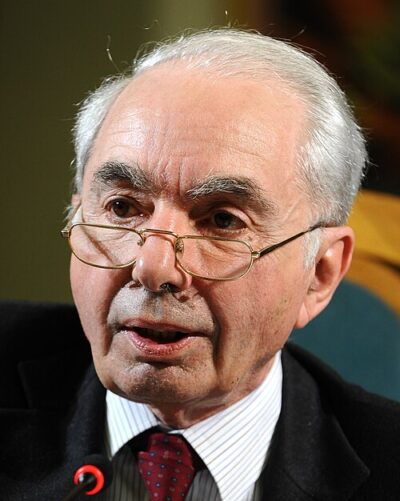
Giuliano Amato
Giuliano Amato is an Italian politician. Born May 13, 1938, in Turin. Positions held include Prime Minister of Italy (2 times) (1992–2001), Italian Minister of the Interior (2006–2008) and member of the Senate of the Italian Republic (2001–2006). Educated at Scuola Normale Superiore and Columbia Law School. Awards include Knight Grand Cross of the Order of Merit of the Italian Republic, honorary doctor of the University of Neuchâtel and Knight Grand Cross of the Order of St Michael and St George.
Facts
41 facts · 1 confirmed by two sources · 6 cited · 34 from one source
Where this comes from
Papalocal keeps its own record. It started from these sources; what each one said is kept here as it was copied, so a change on their side never changes this page by itself. Tap one to read its version.
What Wikidata says · copied November 16, 2026 · revision 2562799904
- Described as
- Italian politician (born 1938)
- Born
- May 13, 1938 · 4 references
- Born in
- Turin · 1 reference
- Name at birth
- Giuliano Amato
- Citizen of
- Kingdom of Italy (–1946); Italy (1946–)
- Occupation
- politician · 2 references; jurist; judge; university teacher
- Positions held
- Prime Minister of Italy (2 times) (1992–2001); Italian Minister of the Interior (2006–2008); member of the Senate of the Italian Republic (2001–2006) · 1 reference; member of the Chamber of Deputies of the Italian Republic (2 times) (1983–2008) · 1 reference; judge of the Constitutional Court of Italy; ICDP commissioner and Vice president; Vice President of the Council of Ministers of Italy (1987–1988); Minister of Treasury (1987–1989); Italian Minister of Foreign Affairs (2 times) (1992–2001); Italian Minister of Justice (1993); Minister of Universities, Science and Technology (2001); Minister of the Treasury, Budget and Economic Planning (1999–2000); Minister for Institutional Reforms (1998–1999); Italian Finance Minister (1993); Minister of the Treasury of Italy (1987–1989)
- Political party
- Italian Socialist Party; Democratic Party
- Worked for
- University of Florence; Sapienza University of Rome; University of Perugia · 1 reference
- Education
- Scuola Normale Superiore; Columbia Law School; European University Institute; University of Pisa; Sant'Anna School of Advanced Studies · 1 reference
- Member of
- American Academy of Arts and Sciences; Associazione italiana dei costituzionalisti · 1 reference
- Awards
- Knight Grand Cross of the Order of Merit of the Italian Republic (2011) · 1 reference; honorary doctor of the University of Neuchâtel (2006) · 1 reference; Knight Grand Cross of the Order of St Michael and St George; Fellow of the American Academy of Arts and Sciences
- Spouse
- Diana Vincenzi Amato
- Wikipedias with a page
- 68
Wikidata item Q202209 (wikidata.org/wiki/Q202209), public domain (CC0). Copied November 16, 2026.
What Wikipedia says · copied November 16, 2026 · revision 1373139119
Giuliano Amato (Italian pronunciation: [dʒuˈljaːno aˈmaːto]; born 13 May 1938) is an Italian politician who twice served as Prime Minister of Italy, first from 1992 to 1993 and again from 2000 to 2001. Upon Arnaldo Forlani's death in July 2023, Amato became the country's earliest-serving surviving Prime Minister.
Later, he was Vice President of the Convention on the Future of Europe that drafted the European Constitution and headed the Amato Group. He is commonly nicknamed dottor Sottile, which means "Doctor Subtilis", the sobriquet of the Scottish Medieval philosopher John Duns Scotus, a reference to his political subtlety. From 2006 to 2008, he was the Minister of the Interior in Romano Prodi's government. He served on the Constitutional Court of Italy from September 2013 to September 2022, to which he was appointed by President Giorgio Napolitano. He also served as President of the Court from 29 January 2022 to 18 September 2022.
- Born, in its opening lines
- May 13, 1938
From the Wikipedia article “Giuliano Amato” (en.wikipedia.org/wiki/Giuliano_Amato), by its contributors, under CC BY-SA 4.0 (creativecommons.org/licenses/by-sa/4.0/). Copied November 16, 2026; not changed.
Confirmed Two sources agree. Cited One source, and it names where it got it. One source One source, without a reference of its own. Sources disagree The sources disagree. We show the best-supported value and keep theirs below.
