
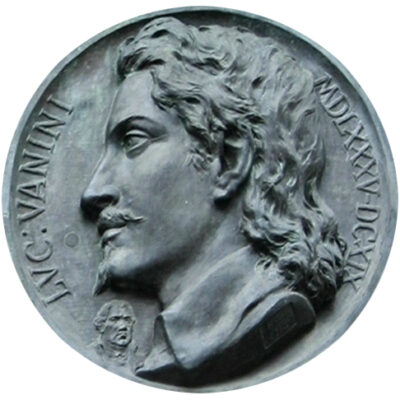
Giulio Cesare Vanini was an Italian philosopher. Born 1585, in Taurisano. Died February 9, 1619, in Toulouse. Positions held include chaplain.
Facts
16 facts · 2 confirmed by two sources · 6 cited · 8 from one source
Where this comes from
Papalocal keeps its own record. It started from these sources; what each one said is kept here as it was copied, so a change on their side never changes this page by itself. Tap one to read its version.
What Wikidata says · copied November 16, 2026 · revision 2564353922
- Described as
- Italian philosopher
- Other names
- Lucilio Vanini
- Born
- 1585 · 18 references
- Died
- February 9, 1619 · 3 references
- Born in
- Taurisano · 1 reference
- Died in
- Toulouse · 1 reference
- Cause of death
- death by burning
- Occupation
- philosopher; physician; naturalist; astrologer; writer · 1 reference
- Positions held
- chaplain
- Field
- philosophy · 1 reference; medicine · 1 reference; natural science · 1 reference; literature · 1 reference
- Religion
- Catholicism
- Wikipedias with a page
- 32
Wikidata item Q553128 (wikidata.org/wiki/Q553128), public domain (CC0). Copied November 16, 2026.
What Wikipedia says · copied November 16, 2026 · revision 1370232258
Lucilio Vanini (1585 – 9 February 1619), who, in his works, styled himself Giulio Cesare Vanini, was an Italian philosopher, physician and free-thinker, who was one of the first significant representatives of intellectual libertinism. He was among the first modern thinkers who viewed the universe as an entity governed by natural laws (nomological determinism). He was also an early literate proponent of biological evolution, maintaining that humans and other apes have common ancestors. He was executed in Toulouse.
Vanini was born at Taurisano near Lecce, and studied philosophy and theology at Naples. Afterwards, he applied himself to the physical studies, chiefly medicine and astronomy, which had come into vogue with the Renaissance. Like Giordano Bruno, he attacked scholasticism.
From Naples he went to Padua, where he came under the influence of the Alexandrist Pietro Pomponazzi, whom he styled his divine master. Subsequently, he led a roving life in France, Switzerland and the Low Countries, supporting himself by giving lessons and disseminating radical ideas. He was obliged to flee to England in 1612 but was imprisoned in London for 49 days.
Returning to Italy, he made an attempt to teach in Genoa but was driven again to France, where he tried to clear himself of suspicion by publishing a book against atheism: Amphitheatrum Aeternae Providentiae Divino-Magicum (1615). Though the definitions of God are somewhat pantheistic, the book served its immediate purpose. Although Vanini did not expound his true views in his first book, he did in his second: De Admirandis Naturae Reginae Deaeque Mortalium Arcanis (Paris, 1616). This was originally certified by two doctors of the Sorbonne, but was later re-examined and condemned.
Vanini then left Paris, where he had been staying as chaplain to the Marechal de Bassompierre, and began to teach in Toulouse. In November 1618, he was arrested and, after a prolonged trial, was condemned to have his tongue cut out, to be strangled at the stake and to have his body burned to ashes. The execution was carried out on 9 February 1619 by local authorities.
- Born, in its opening lines
- 1585
- Died, in its opening lines
- February 9, 1619
From the Wikipedia article “Lucilio Vanini” (en.wikipedia.org/wiki/Lucilio_Vanini), by its contributors, under CC BY-SA 4.0 (creativecommons.org/licenses/by-sa/4.0/). Copied November 16, 2026; not changed.
Confirmed Two sources agree. Cited One source, and it names where it got it. One source One source, without a reference of its own. Sources disagree The sources disagree. We show the best-supported value and keep theirs below.
