
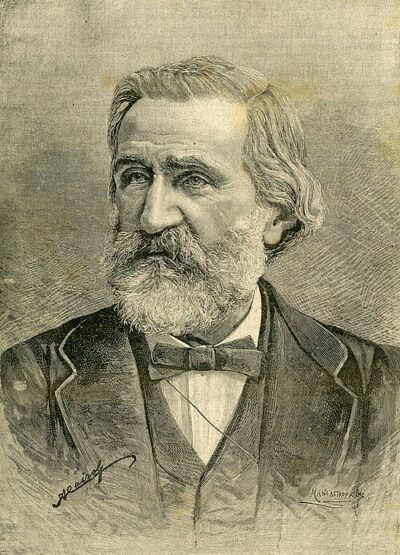
Giuseppe Verdi
Giuseppe Verdi was an Italian opera composer. Born October 10, 1813, in Le Roncole. Died January 27, 1901, in Milan. Positions held include member of the Chamber of Deputies of the Kingdom of Italy (1861–1865) and senator of the Kingdom of Italy (1874–1876). Known for La traviata, Rigoletto and Aida. Awards include Pour le Mérite for Sciences and Arts order, Knight Grand Cross of the Order of Saints Maurice and Lazarus and Order of Saint Stanislaus.
Facts
49 facts · 2 confirmed by two sources · 14 cited · 33 from one source
Where this comes from
Papalocal keeps its own record. It started from these sources; what each one said is kept here as it was copied, so a change on their side never changes this page by itself. Tap one to read its version.
What Wikidata says · copied November 16, 2026 · revision 2568870958
- Described as
- Italian opera composer (1813–1901)
- Other names
- Giuseppe Fortunino Francesco Verdi, Verdi
- Born
- October 10, 1813 · 15 references
- Died
- January 27, 1901 · 16 references
- Born in
- Le Roncole · 1 reference
- Died in
- Milan · 4 references
- Buried in
- Casa di Riposo per Musicisti
- Cause of death
- stroke
- Citizen of
- Duchy of Parma and Piacenza; Kingdom of Italy (1861–)
- Occupation
- composer · 1 reference; conductor; writer; politician · 2 references
- Positions held
- member of the Chamber of Deputies of the Kingdom of Italy (1861–1865); senator of the Kingdom of Italy (1874–1876)
- Political party
- Historical Right · 1 reference
- Member of
- Royal Swedish Academy of Music; Académie des beaux-arts
- Genre
- classical music; opera
- Instrument
- piano
- Known for
- La traviata; Rigoletto; Aida; Nabucco; Il trovatore; Messa da Requiem; Falstaff; Quattro Pezzi Sacri
- Awards
- Pour le Mérite for Sciences and Arts order; Knight Grand Cross of the Order of Saints Maurice and Lazarus (1887) · 1 reference; Order of Saint Stanislaus (1862) · 1 reference; Knight of the Legion of Honour (1847) · 1 reference; Grand Cross of the Legion of Honour (1894) · 1 reference; Civil Order of Savoy; Order of the Medjidie; Knight grand cross of the order of the crown of Italy; Commander's Cross of the Order of Franz Joseph; Grand Officer of the Legion of Honour (1880) · 1 reference
- Field
- art music · 1 reference; music · 1 reference; opera · 1 reference; conducting · 1 reference; politics · 1 reference
- Spouse
- Margherita Barezzi (1836–1840); Giuseppina Strepponi (1859–1897) · 1 reference
- Children
- Maria Carrara Verdi
- Religion
- Roman Catholic
- Website
- http://giuseppeverdi.it; http://www.verdi.san.beniculturali.it
- Wikipedias with a page
- 180
Wikidata item Q7317 (wikidata.org/wiki/Q7317), public domain (CC0). Copied November 16, 2026.
What Wikipedia says · copied November 16, 2026 · revision 1383069537
Giuseppe Fortunino Francesco Verdi ( VAIR-dee; Italian: [dʒuˈzɛppe ˈverdi]; 9 or 10 October 1813 – 27 January 1901) was an Italian composer best known for his operas. He was born near Busseto, a small town in the modern province of Parma, to a family of moderate means, receiving a musical education with the help of a local patron named Antonio Barezzi.
Verdi came to dominate the Italian opera scene after the era of Gioachino Rossini, Vincenzo Bellini, and Gaetano Donizetti, whose works significantly influenced him. He was also strongly influenced by the French Grand opera style, particularly Giacomo Meyerbeer and Gaspare Spontini.
In his early operas, Verdi demonstrated sympathy with the Risorgimento movement which sought the unification of Italy. He also served briefly as an elected politician. The chorus "Va, pensiero" from his early opera Nabucco (1842), and similar choruses in later operas, were much in the spirit of the unification movement, and the composer himself became esteemed as a representative of these ideals. Macbeth (1847) has been called his first masterpiece.
An intensely private person, Verdi did not seek to ingratiate himself with popular movements. As he became professionally successful, he was able to reduce his operatic workload and sought to establish himself as a landowner in his native region. He found further fame with the three peaks of his "middle period": Rigoletto (1851), Il trovatore and La traviata (both 1853). He surprised the musical world by returning, after his success with the opera Aida (1871), with three late masterpieces: his Requiem (1874), and the operas Otello (1887) and Falstaff (1893). Verdi's operas remain among the most popular in the repertoire. In 2013, the bicentenary of his birth was widely celebrated around the world with television and radio broadcasts and live performances.
- Born, in its opening lines
- October 10, 1813
- Died, in its opening lines
- January 27, 1901
From the Wikipedia article “Giuseppe Verdi” (en.wikipedia.org/wiki/Giuseppe_Verdi), by its contributors, under CC BY-SA 4.0 (creativecommons.org/licenses/by-sa/4.0/). Copied November 16, 2026; not changed.
Confirmed Two sources agree. Cited One source, and it names where it got it. One source One source, without a reference of its own. Sources disagree The sources disagree. We show the best-supported value and keep theirs below.
