
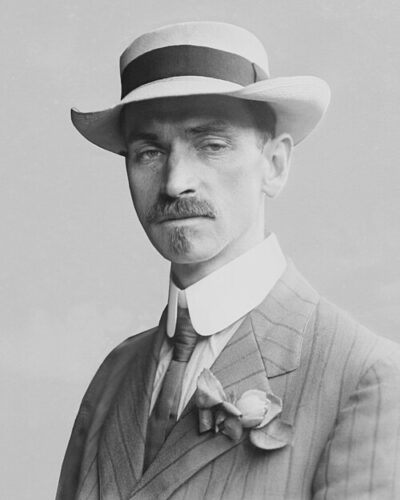
Glenn Curtiss
Glenn Curtiss was an American aviator and industrialist. Born May 21, 1878, in Hammondsport. Died July 23, 1930, in Buffalo. Awards include National Aviation Hall of Fame, National Inventors Hall of Fame and Langley Gold Medal.
Facts
26 facts · 2 confirmed by two sources · 6 cited · 18 from one source
Where this comes from
Papalocal keeps its own record. It started from these sources; what each one said is kept here as it was copied, so a change on their side never changes this page by itself. Tap one to read its version.
What Wikidata says · copied November 15, 2026 · revision 2559646237
- Described as
- American aviator and industrialist (1878-1930)
- Other names
- Glenn Hammond Curtiss, Glenn H. Curtiss
- Born
- May 21, 1878 · 9 references
- Died
- July 23, 1930 · 7 references
- Born in
- Hammondsport · 2 references
- Died in
- Buffalo · 1 reference
- Buried in
- Pleasant Valley Cemetery · 1 reference
- Cause of death
- appendicitis
- Citizen of
- United States
- Occupation
- aircraft pilot; military flight engineer; sport cyclist; racing automobile driver; inventor; businessperson · 1 reference; aircraft designer · 1 reference
- Worked for
- Kodak; Western Union; Curtiss
- Member of
- Aerial Experiment Association
- Sport
- cycle sport
- Awards
- National Aviation Hall of Fame (1964) · 1 reference; National Inventors Hall of Fame (2003) · 1 reference; Langley Gold Medal (1913) · 1 reference; Collier Trophy (1911); honorary doctor of the University of Miami (1930) · 1 reference
- Field
- aerospace engineering; mechanical engineering
- Wikipedias with a page
- 31
Wikidata item Q454544 (wikidata.org/wiki/Q454544), public domain (CC0). Copied November 15, 2026.
What Wikipedia says · copied November 15, 2026 · revision 1382218216
Glenn Hammond Curtiss (May 21, 1878 – July 23, 1930) was an American aviation and motorcycling pioneer, and a founder of the U.S. aircraft industry. He began his career as a bicycle racer and builder before moving on to motorcycles. As early as 1904, he began to manufacture engines for airships, and with his V8 engine in the Curtiss V-8 motorcycle, on January 24, 1907, Curtiss set an unofficial world speed record, for all kinds of vehicles, that was not broken until 1911.
In 1907, Curtiss joined the Aerial Experiment Association, a pioneering research group, founded by Alexander Graham Bell at Beinn Bhreagh, Nova Scotia, to build flying machines. On July 4, 1908, he flew nearly a mile with the AEA June Bug, recording the first public flight in North America. It won him the Scientific American prize, and also a lawsuit with the Wright Brothers, who had declined to fly in public.
In 1909, Curtiss won the Gordon Bennett Aviation Trophy at the world's first international air meet in France, the Grande Semaine d'Aviation de la Champagne. In 1910 he made the first long-distance flight in the U.S., across NY state. His contributions in designing and building aircraft, like the use of ailerons, led to the formation of the Curtiss Aeroplane and Motor Company, which later merged into the Curtiss-Wright Corporation. His company built aircraft for the U.S. Army and Navy, and, during the years leading up to World War I, his experiments with seaplanes led to advances in naval aviation. Curtiss civil and military aircraft were some of the most important types in the interwar and World War II eras.
- Born, in its opening lines
- May 21, 1878
- Died, in its opening lines
- July 23, 1930
From the Wikipedia article “Glenn Curtiss” (en.wikipedia.org/wiki/Glenn_Curtiss), by its contributors, under CC BY-SA 4.0 (creativecommons.org/licenses/by-sa/4.0/). Copied November 15, 2026; not changed.
Confirmed Two sources agree. Cited One source, and it names where it got it. One source One source, without a reference of its own. Sources disagree The sources disagree. We show the best-supported value and keep theirs below.
