
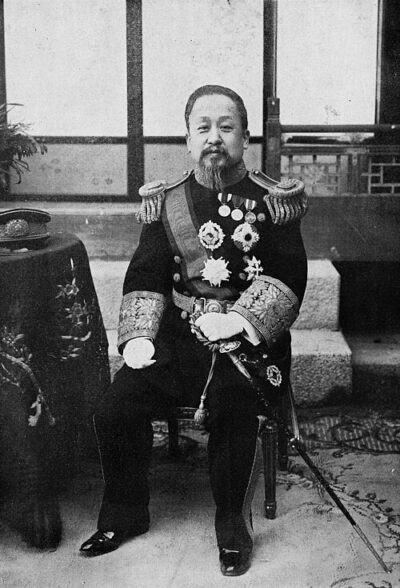
Gojong of the Korean Empire
Gojong of the Korean Empire was the 26th king of Joseon, first emperor of the Korean Empire. Born September 8, 1852, in Unhyeongung. Died January 21, 1919, in Deoksugung. Positions held include king of Joseon Dynasty (1863–1897) and Emperor of Korea (1897–1907). Awards include Order of Saint Stanislaus, 1st class, Order of St. Andrew and Collar of the Supreme Order of the Chrysanthemum.
Facts
34 facts · 2 confirmed by two sources · 1 cited · 30 from one source · 1 where the sources disagree
What’s different
- Name at birth: we show 이재황 (Sources disagree). Wikidata also lists 고종, 高宗, 이명복(아명), 이재황(초명)
Where this comes from
Papalocal keeps its own record. It started from these sources; what each one said is kept here as it was copied, so a change on their side never changes this page by itself. Tap one to read its version.
What Wikidata says · copied November 16, 2026 · revision 2565761433
- Described as
- 26th king of Joseon, first emperor of the Korean Empire (1852–1919)
- Other names
- Lee Hee
- Born
- September 8, 1852 · 1 reference
- Died
- January 21, 1919 · 1 reference
- Born in
- Unhyeongung
- Died in
- Deoksugung
- Cause of death
- poison
- Name at birth
- 이재황; 고종, 高宗, 이명복(아명), 이재황(초명)
- Citizen of
- Joseon (–1897); Korean Empire (1897–); Korea
- Occupation
- monarch; king
- Positions held
- king of Joseon Dynasty (1863–1897); Emperor of Korea (1897–1907)
- Awards
- Order of Saint Stanislaus, 1st class; Order of St. Andrew (1902); Collar of the Supreme Order of the Chrysanthemum; Grand Cross of the Legion of Honour; Order of Saints Maurice and Lazarus
- Spouse
- Empress Myeongseong (1866–1895); Imperial Consort Sunheon (1897–1911); Yeongbodang Yi (–1919); Imperial Consort Gwi-in of the Deoksu Jang clan; Imperial Consort Gwiin Jeong (–1919); Imperial Consort Gwiin Yang (1912–1919)
- Children
- Prince Wanhwa; Sunjong of the Korean Empire; Prince Yi Kang; Yi Un; Deokhye, Princess of Korea
- Father
- Heungseon Daewongun
- Mother
- Sunmok Budaebuin
- Siblings
- Prince Imperial Waneun; Heung
- Lived in
- Seoul · 1 reference
- Wikipedias with a page
- 47
Wikidata item Q257425 (wikidata.org/wiki/Q257425), public domain (CC0). Copied November 16, 2026.
What Wikipedia says · copied November 16, 2026 · revision 1385703703
Gojong (Korean: 고종; Hanja: 高宗; 8 September 1852 – 21 January 1919), personal name Yi Jaehwang, later changed to Yi Hui, also known as the Gwangmu Emperor, was the penultimate Korean monarch. He ruled Korea for 43 years, from 1864 until his forced abdication in 1907, initially as the 26th king of Joseon, and then as the first emperor of the Korean Empire. His wife, Queen Min (commonly known as Empress Myeongseong), played an active role in politics until her assassination carried out by the Japanese.
Gojong oversaw the bulk of the Korean monarchy's final years. He was born into a distant branch of the ruling House of Yi (a descendant of Grand Prince Inpyeong, the third son of King Injo), and acceded to the throne at the age of 11, upon the death of his nominal uncle, the heirless King Cheoljong. His biological father, Grand Internal Prince Heungseon (widely known as Heungseon Daewongun), acted as regent until he reached the age of majority, although he continued holding power until 1874. At this time, Korea was under policies of strict isolationism. By contrast, Japan had been rapidly modernizing under the Meiji Restoration. In 1876, Japan forcefully opened up Korea and began a decades-long process of moving the peninsula into its own sphere of influence. For the following few decades, Korea was highly unstable, and subjected to a number of foreign encroachments. Events such as the 1882 Imo Incident, the 1884 Kapsin Coup, the 1894–1895 Tonghak Peasant Revolution, and the 1895 assassination of Gojong's wife occurred during his reign. All of these events were related to or involved foreign powers.
All the while, Gojong attempted to consolidate control, seek foreign support, and modernize the country in order to keep Korea independent. He initiated the Gwangmu Reform, which sought to improve the military, industry, and education, to some amount of success. These reforms were seen as insufficient by some parts of the Korean literati, especially the Independence Club, which Gojong at first tolerated but eventually abolished in 1898. After Japan defeated China in the 1894–1895 First Sino-Japanese War, China lost its suzerainty over Korea, which it had held for centuries. In 1897, shortly after returning from his internal exile in the Russian legation in Seoul, Gojong proclaimed the establishment of the independent Korean Empire, and became its first emperor. Gojong's actions drew the ire of Japan. After Japan defeated Russia in the 1904–1905 Russo-Japanese War, it finally became the sole power in the region, and accelerated its pace of absorbing Korea. Two months after the victory, Korea under Gojong lost diplomatic sovereignty in the Japan–Korea Treaty of 1905, signed by the Five Eulsa Traitors. Gojong refused to sign it and made attempts to bring the treaty to the attention of the international community and convince leading powers of the treaty's illegitimacy, but to no avail.
Gojong was forced to abdicate in 1907, and was replaced by his son, Yi Cheok. He was then confined to Deoksugung. He made multiple attempts to escape and establish a government-in-exile abroad, but was unsuccessful each time. Korea formally became a Japanese colony in 1910, and the Korean imperial family was formally absorbed into the Japanese Imperial house. Gojong died on 21 January 1919, in conditions that were and still are seen in Korea as suspicious. The official cause of death was cerebral hemorrhage but rumors persisted that Gojong had been poisoned by Japan. His death was a direct catalyst for the March First Movement, which in turn bolstered the Korean independence movement.
- Born, in its opening lines
- September 8, 1852
- Died, in its opening lines
- January 21, 1919
From the Wikipedia article “Gojong of Korea” (en.wikipedia.org/wiki/Gojong_of_Korea), by its contributors, under CC BY-SA 4.0 (creativecommons.org/licenses/by-sa/4.0/). Copied November 16, 2026; not changed.
Confirmed Two sources agree. Cited One source, and it names where it got it. One source One source, without a reference of its own. Sources disagree The sources disagree. We show the best-supported value and keep theirs below.
