
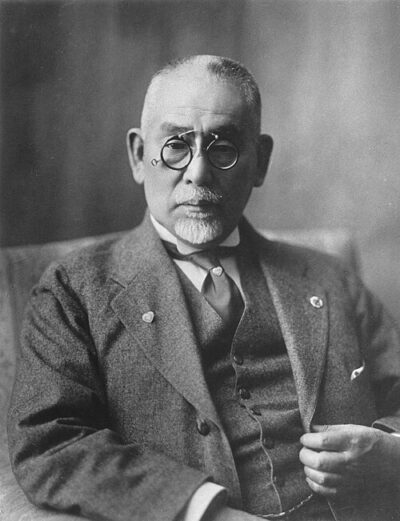
Gotō Shinpei
Gotō Shinpei was a Japanese statesman. Born July 24, 1857, in Mizusawa. Died April 13, 1929, in University Hospital, Kyoto Prefectural University of Medicine. Positions held include Minister of Internal Affairs and Communications, Mayor of Tokyo (1920–1923) and member of the House of Peers (1903–). Educated at Iwase General Hospital. Awards include Order of the Rising Sun with Paulownia Flowers, 1st class, Order of the Rising Sun, 1st class and 1st Class Order of the Crown.
Facts
32 facts · 2 confirmed by two sources · 4 cited · 26 from one source
Where this comes from
Papalocal keeps its own record. It started from these sources; what each one said is kept here as it was copied, so a change on their side never changes this page by itself. Tap one to read its version.
What Wikidata says · copied November 18, 2026 · revision 2562788084
- Described as
- Japanese statesman (1857-1929)
- Other names
- Goto Shinpei, Gotou Shinpei
- Born
- July 24, 1857 · 2 references
- Died
- April 13, 1929 · 3 references
- Born in
- Mizusawa
- Died in
- University Hospital, Kyoto Prefectural University of Medicine
- Buried in
- Aoyama Cemetery
- Cause of death
- intracranial hemorrhage
- Citizen of
- Empire of Japan
- Occupation
- diplomat; physician · 1 reference; politician · 1 reference; businessperson · 1 reference; statesperson · 1 reference
- Positions held
- Minister of Internal Affairs and Communications; Mayor of Tokyo (1920–1923); member of the House of Peers (1903–)
- Political party
- Rikken Dōshikai
- Worked for
- Takushoku University; Nagoya University School of Medicine
- Education
- Iwase General Hospital · 1 reference
- Awards
- Order of the Rising Sun with Paulownia Flowers, 1st class (1920); Order of the Rising Sun, 1st class (1906); 1st Class Order of the Crown (1908); Order of the White Eagle (1908); Grand Cross of the Order of Henry the Lion (1910); Knight Grand Cross of the Order of the British Empire (1918); Order of the Precious Brilliant Golden Grain (1918); Grand Cross of the Order of the Crown (1919); Grand Cross of the Order of Polonia Restituta (1923); Order of the Sacred Treasure, 5th Class (1897); Order of the Sacred Treasure, 4th class (1899); Order of the Sacred Treasure, 3rd class (1901)
- Field
- politics · 1 reference
- Wikipedias with a page
- 23
Wikidata item Q562492 (wikidata.org/wiki/Q562492), public domain (CC0). Copied November 18, 2026.
What Wikipedia says · copied November 18, 2026 · revision 1383913871
Count Gotō Shinpei (後藤 新平; 24 July 1857 – 13 April 1929) was a Japanese politician, physician and cabinet minister of the Taishō and early Shōwa period Empire of Japan. He served as the head of civilian affairs of Japanese Taiwan, the first director of the South Manchuria Railway, the seventh mayor of Tokyo City, the first Chief Scout of Japan, the first Director-General of NHK, the third principal of Takushoku University, and in a number of cabinet posts. Gotō was one of the most important politicians and administrators in Japanese national government during a time of modernization and reform in the late nineteenth and early twentieth centuries. He was also an advocate for Japanese colonialism.
- Born, in its opening lines
- July 24, 1857
- Died, in its opening lines
- April 13, 1929
From the Wikipedia article “Gotō Shinpei” (en.wikipedia.org/wiki/Gotō_Shinpei), by its contributors, under CC BY-SA 4.0 (creativecommons.org/licenses/by-sa/4.0/). Copied November 18, 2026; not changed.
Confirmed Two sources agree. Cited One source, and it names where it got it. One source One source, without a reference of its own. Sources disagree The sources disagree. We show the best-supported value and keep theirs below.
