
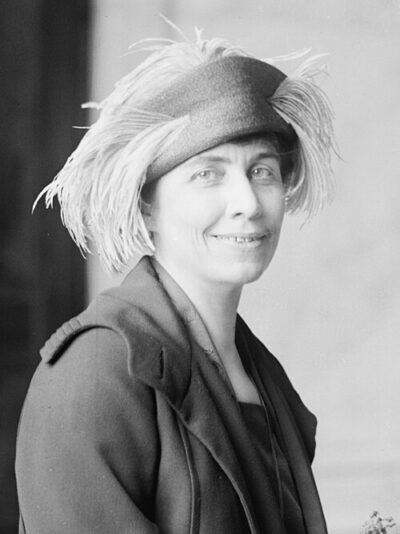
Grace Coolidge
Grace Coolidge was a First Lady of the United States from 1923 to 1929. Born January 3, 1879, in Burlington. Died July 8, 1957, in Plymouth. Positions held include First Lady of the United States (1923–1929) and Second Lady or Gentleman of the United States (1921–1923). Educated at University of Vermont and Burlington High School. Awards include gold medal.
Facts
26 facts · 2 confirmed by two sources · 15 cited · 9 from one source
Where this comes from
Papalocal keeps its own record. It started from these sources; what each one said is kept here as it was copied, so a change on their side never changes this page by itself. Tap one to read its version.
What Wikidata says · copied November 13, 2026 · revision 2558586470
- Described as
- First Lady of the United States from 1923 to 1929
- Other names
- Grace Goodhue Coolidge, Grace Anna Goodhue, Grace Goodhue, Grace Anna Coolidge, Grace Anna Goodhue Coolidge
- Born
- January 3, 1879 · 7 references
- Died
- July 8, 1957 · 7 references
- Born in
- Burlington · 2 references
- Died in
- Plymouth · 1 reference
- Buried in
- Plymouth Notch Cemetery · 1 reference
- Name at birth
- Grace Anna Goodhue Coolidge · 1 reference
- Citizen of
- United States
- Occupation
- politician · 1 reference; teacher · 1 reference
- Positions held
- First Lady of the United States (1923–1929); Second Lady or Gentleman of the United States (1921–1923)
- Political party
- Republican Party
- Education
- University of Vermont (1898–1902); Burlington High School (1893–1897); Clarke Schools for Hearing and Speech (1902–1904)
- Member of
- American Red Cross · 1 reference; Pi Beta Phi · 1 reference
- Awards
- gold medal (1931) · 1 reference
- Spouse
- Calvin Coolidge (1905–1933) · 1 reference
- Children
- Calvin Coolidge, Jr. · 1 reference; John Coolidge · 3 references
- Father
- Andrew I. Goodhue · 2 references
- Mother
- Lemira Barrett · 2 references
- Religion
- Congregational churches
- Lived in
- Northampton · 1 reference; Washington, D.C. · 1 reference
- Wikipedias with a page
- 47
Wikidata item Q234287 (wikidata.org/wiki/Q234287), public domain (CC0). Copied November 13, 2026.
What Wikipedia says · copied November 13, 2026 · revision 1381842716
Grace Anna Coolidge (née Goodhue; January 3, 1879 – July 8, 1957) was first lady of the United States from 1923 to 1929 as the wife of the 30th president of the United States, Calvin Coolidge. She was previously the second lady of the United States from 1921 to 1923 and the first lady of Massachusetts from 1919 to 1921.
Coolidge was born and raised in Burlington, Vermont, and attended the University of Vermont where she co-founded the school's chapter of Pi Beta Phi. She moved to Northampton, Massachusetts, to teach at Clarke School for the Deaf. She met Calvin Coolidge in Northampton, and they married in 1905. They had two sons. She stayed in Northampton to raise their children while her husband's political career progressed in Boston. The family moved to Washington, D.C. when Coolidge was elected vice president in 1921, and into the White House after the death of Warren G. Harding, in 1923.
Coolidge was active as first lady, hosting thousands of guests each year, and she made regular public appearances in the President's stead. She was popular and highly regarded for her ability to charm visitors. Her fashion choices were influential among American women as she wore a variety of hats and chose modest versions of contemporary designs. Coolidge distanced herself from the politically active first ladies who preceded her, though she quietly took interest in helping women's groups and the deaf. She felt restricted by the role of first lady; she believed that it took priority over her own interests, and she was subject to many rules imposed on her by her husband. She was much affected by the death of her younger son in 1924, though she interrupted her duties as the White House hostess only for a few weeks. In the final year of her tenure, Coolidge was afflicted with a kidney disease which left her temporarily debilitated.
The Coolidges returned to Northampton in 1929, where Coolidge began publishing poetry and autobiographical essays. Following her husband's death in 1933, she became more independent and began traveling. Coolidge was an advocate of American involvement in World War II, and she lent her house to WAVES when the U.S. entered the war. She remained active on the board of Clarke School and in programs for the deaf until her death in 1957.
- Born, in its opening lines
- January 3, 1879
- Died, in its opening lines
- July 8, 1957
From the Wikipedia article “Grace Coolidge” (en.wikipedia.org/wiki/Grace_Coolidge), by its contributors, under CC BY-SA 4.0 (creativecommons.org/licenses/by-sa/4.0/). Copied November 13, 2026; not changed.
Confirmed Two sources agree. Cited One source, and it names where it got it. One source One source, without a reference of its own. Sources disagree The sources disagree. We show the best-supported value and keep theirs below.
