
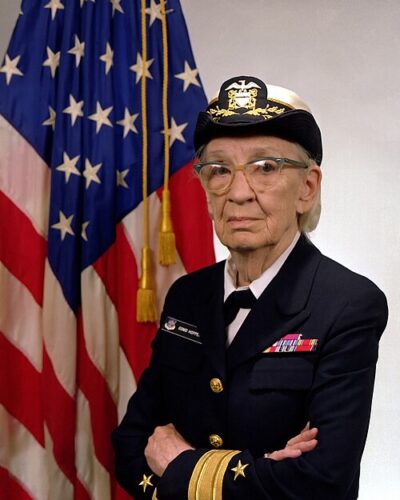
Grace Hopper
Grace Hopper was an American computer scientist and United States Navy officer. Born December 9, 1906, in New York City. Died January 1, 1992, in Arlington County. Known for FLOW-MATIC. Educated at Vassar College and Yale University (2 times). Awards include Defense Distinguished Service Medal, Legionnaire of Legion of Merit and National Medal of Technology and Innovation.
Facts
52 facts · 2 confirmed by two sources · 31 cited · 19 from one source
Where this comes from
Papalocal keeps its own record. It started from these sources; what each one said is kept here as it was copied, so a change on their side never changes this page by itself. Tap one to read its version.
What Wikidata says · copied November 13, 2026 · revision 2568623673
- Described as
- American computer scientist and United States Navy officer (1906–1992)
- Other names
- Grace Murray Hopper, Grace M. Hopper, Admiral Hopper, Grace Brewster Murray, Grace Brewster Murray Hopper, Rear Admiral Grace Hopper, Grace Murray, Grace Brewster Hopper
- Born
- December 9, 1906 · 4 references
- Died
- January 1, 1992 · 4 references
- Born in
- New York City · 1 reference
- Died in
- Arlington County · 3 references
- Buried in
- Arlington National Cemetery (1992) · 1 reference
- Name at birth
- Grace Brewster Murray
- Citizen of
- United States
- Occupation
- mathematician · 3 references; naval officer; computer scientist · 2 references; university teacher; programmer · 3 references; physicist · 1 reference
- Worked for
- Eckert–Mauchly Computer Corporation (1949–1971); Vassar College (1931–1943) · 1 reference; Remington Rand (1950–1955) · 1 reference; Bureau of Ships (1943–1949) · 1 reference; Sperry Corporation (1955–1966) · 1 reference; Naval Sea Systems Command (1966–1986) · 1 reference; Digital Equipment Corporation (1986–1990) · 1 reference
- Education
- Vassar College (1924–1928) · 2 references; Yale University (2 times) (1928–1934) · 3 references; Wardlaw-Hartridge School (1923–1924) · 1 reference
- Member of
- American Academy of Arts and Sciences; Daughters of the American Revolution; Phi Beta Kappa Society; American Association for the Advancement of Science · 1 reference; Graduate Women in Science
- Known for
- FLOW-MATIC · 1 reference
- Awards
- Defense Distinguished Service Medal (1985) · 1 reference; Legionnaire of Legion of Merit (1973) · 1 reference; National Medal of Technology and Innovation (1991) · 2 references; National Women's Hall of Fame (1994) · 1 reference; IEEE Emanuel R. Piore Award (1988) · 1 reference; American Campaign Medal; Distinguished Fellow of the British Computer Society (1973) · 2 references; Presidential Medal of Freedom (2016) · 1 reference; Computer History Museum Fellow (1987) · 1 reference; Wilbur Cross Medal (1972) · 1 reference; World War II Victory Medal; W. Wallace McDowell Award (1979); Meritorious Service Medal; National Defense Service Medal; Society of Women Engineers Achievement Award (1964) · 1 reference
- Field
- computer science · 1 reference
- Spouse
- Vincent Foster Hopper (1930–1945) · 1 reference
- Father
- Walter Fletcher Murray · 1 reference
- Mother
- Mary Campbell van Horne · 1 reference
- Military branch
- United States Navy
- Military rank
- rear admiral (1985–) · 1 reference
- Lived in
- New York City
- Nickname
- Amazing Grace
- Wikipedias with a page
- 87
Wikidata item Q11641 (wikidata.org/wiki/Q11641), public domain (CC0). Copied November 13, 2026.
What Wikipedia says · copied November 13, 2026 · revision 1383753371
Grace Brewster Hopper (née Murray; December 9, 1906 – January 1, 1992) was an American computer scientist, mathematician, and United States Navy rear admiral. She was a pioneer of computer programming. Hopper was the first to devise the theory of machine-independent programming languages, and used this theory to develop the FLOW-MATIC programming language, which was a major influence on COBOL, an early high-level programming language still in use today. She was also one of the first programmers on the Harvard Mark I computer. She is credited with writing the first computer manual, "A Manual of Operation for the Automatic Sequence Controlled Calculator", and is often credited with creating the first compiler.
Before joining the Navy, Hopper earned a Ph.D. in mathematics from Yale University and was a professor of mathematics at Vassar College. She left her position at Vassar to join the United States Navy Reserve during World War II. Hopper began her computing career in 1944 as a member of the Harvard Mark I team, led by Howard H. Aiken. In 1949, she joined the Eckert–Mauchly Computer Corporation and was part of the team that developed the UNIVAC I computer.
At Eckert–Mauchly she managed the development of one of the first COBOL compilers. She believed that programming should be simplified with an English-based computer programming language, which would be translated into machine code through a secondary program called a compiler. By 1952, Hopper had finished her program, which was written for the A-0 System. In 1954, Eckert–Mauchly chose Hopper to lead their department for automatic programming, and she led the release of some of the first compiled languages like FLOW-MATIC. In 1959, she participated in the CODASYL consortium, helping to create a machine-independent programming language called COBOL, which was based on English words. Hopper promoted the use of the language throughout the 1960s.
The U.S. Navy Arleigh Burke-class guided-missile destroyer USS Hopper was named for her, as was the Cray XE6 "Hopper" supercomputer at NERSC, the "Grace" supercomputing cluster at Texas A&M University, and the Nvidia GPU architecture "Hopper". During her lifetime, Hopper was awarded 40 honorary degrees from universities across the world. A college at Yale University was renamed in her honor. In 1991, she received the National Medal of Technology. On November 22, 2016, she was posthumously awarded the Presidential Medal of Freedom by President Barack Obama. In 2024, the Institute of Electrical and Electronics Engineers (IEEE) dedicated a plaque at the University of Pennsylvania in honor of invention the A-0 compiler, that functioned as a linker/loader, by Grace Hopper during her time as a lecturer in the School of Engineering.
- Born, in its opening lines
- December 9, 1906
- Died, in its opening lines
- January 1, 1992
From the Wikipedia article “Grace Hopper” (en.wikipedia.org/wiki/Grace_Hopper), by its contributors, under CC BY-SA 4.0 (creativecommons.org/licenses/by-sa/4.0/). Copied November 13, 2026; not changed.
Confirmed Two sources agree. Cited One source, and it names where it got it. One source One source, without a reference of its own. Sources disagree The sources disagree. We show the best-supported value and keep theirs below.
