
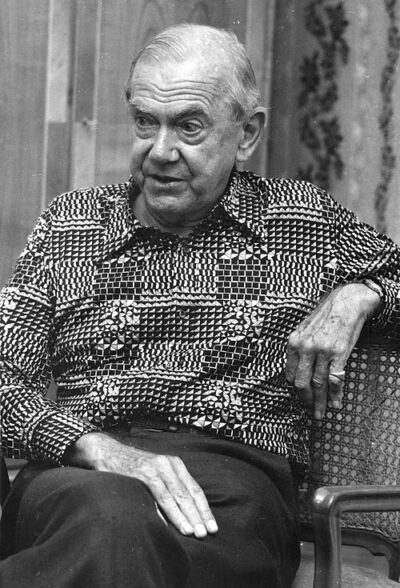
Graham Greene
Graham Greene was a British writer, playwright and literary critic. Born October 2, 1904, in Berkhamsted. Died April 3, 1991, in Vevey. Known for A Gun for Sale, The Power and the Glory and The Third Man. Educated at Balliol College and Berkhamsted School. Awards include James Tait Black Memorial Prize, Hawthornden Prize and The Grand Master.
Facts
51 facts · 2 confirmed by two sources · 31 cited · 17 from one source · 1 where the sources disagree
What’s different
- Died in: we show Vevey (Sources disagree). Wikidata also lists Corseaux
Where this comes from
Papalocal keeps its own record. It started from these sources; what each one said is kept here as it was copied, so a change on their side never changes this page by itself. Tap one to read its version.
What Wikidata says · copied November 16, 2026 · revision 2569009518
- Described as
- British writer, playwright and literary critic (1904–1991)
- Other names
- Greene, Graham, Henry Graham Greene
- Born
- October 2, 1904 · 16 references
- Died
- April 3, 1991 · 16 references
- Born in
- Berkhamsted · 1 reference
- Died in
- Vevey · 1 reference; Corseaux · 1 reference
- Buried in
- Corseaux · 2 references
- Cause of death
- leukemia
- Name at birth
- Henry Graham Greene · 1 reference
- Citizen of
- United Kingdom
- Occupation
- writer · 4 references; novelist · 2 references; playwright · 1 reference; journalist · 3 references; screenwriter · 2 references; autobiographer · 1 reference; children's writer · 1 reference; spy
- Worked for
- Secret Intelligence Service · 1 reference; Le Figaro; The Times
- Education
- Balliol College · 1 reference; Berkhamsted School · 1 reference
- Member of
- Royal Society of Literature
- Known for
- A Gun for Sale (1936); The Power and the Glory (1940); The Third Man (1949); The Quiet American (1955)
- Awards
- James Tait Black Memorial Prize (1948); Hawthornden Prize (1941); The Grand Master (1976) · 1 reference; Shakespeare Prize (1968) · 1 reference; Dos Passos Prize (1980) · 2 references; Jerusalem Prize (1981) · 1 reference; Fellow of the Royal Society of Literature; Commandeur des Arts et des Lettres (1983) · 1 reference
- Field
- novel · 1 reference; film critic · 1 reference; literary critic · 1 reference
- Spouse
- Vivien Greene (1927–1991) · 2 references
- Children
- [Lucy] Caroline Greene · 2 references; Francis Greene · 2 references
- Father
- Charles Henry Greene · 1 reference
- Mother
- Marion Raymond Greene · 1 reference
- Siblings
- Hugh Greene · 1 reference; Elisabeth Katherine Greene · 1 reference; [William] Herbert Greene · 1 reference; Alice Marion Greene · 1 reference; Raymond Greene · 1 reference
- Religion
- Catholicism
- Lived in
- Berkhamsted; Monastery of Santa María a Real of Oseira · 1 reference
- Website
- https://grahamgreenebt.org
- Wikipedias with a page
- 111
Wikidata item Q128560 (wikidata.org/wiki/Q128560), public domain (CC0). Copied November 16, 2026.
What Wikipedia says · copied November 16, 2026 · revision 1385769847
Henry Graham Greene (2 October 1904 – 3 April 1991) was an English writer and journalist regarded by many as one of the leading novelists of the 20th century.
Combining literary acclaim with widespread popularity, Greene acquired a reputation early in his lifetime as a major writer, both of serious Catholic novels, and of thrillers (or "entertainments" as he termed them). He was shortlisted for the Nobel Prize in Literature several times. Through 67 years of writing, which included over 25 novels, he explored the conflicting moral and political issues of the modern world. The Power and the Glory won the 1941 Hawthornden Prize and The Heart of the Matter won the 1948 James Tait Black Memorial Prize and was shortlisted for the Best of the James Tait Black. Greene was awarded the 1968 Shakespeare Prize and the 1981 Jerusalem Prize. Several of his stories have been filmed, some more than once, and he collaborated with filmmaker Carol Reed on The Fallen Idol (1948) and The Third Man (1949).
He converted to Catholicism in 1926 after meeting his future wife, Vivien Dayrell-Browning. Later in life he called himself a "Catholic agnostic".
He died in 1991, aged 86, of leukemia, and was buried in Corseaux cemetery in Switzerland. William Golding called Greene "the ultimate chronicler of twentieth-century man's consciousness and anxiety". V. S. Pritchett called him "the most ingenious, inventive and exciting of our novelists, rich in exactly etched and moving portraits of real human beings and who understands the tragic and comic ironies of love, loyalty and belief."
- Born, in its opening lines
- October 2, 1904
- Died, in its opening lines
- April 3, 1991
From the Wikipedia article “Graham Greene” (en.wikipedia.org/wiki/Graham_Greene), by its contributors, under CC BY-SA 4.0 (creativecommons.org/licenses/by-sa/4.0/). Copied November 16, 2026; not changed.
Confirmed Two sources agree. Cited One source, and it names where it got it. One source One source, without a reference of its own. Sources disagree The sources disagree. We show the best-supported value and keep theirs below.
