
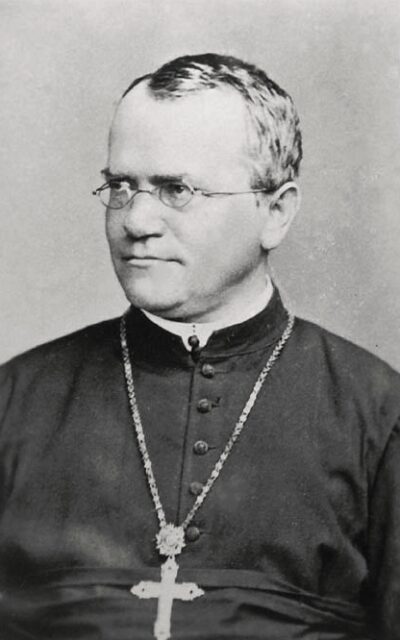
Gregor Mendel
Gregor Mendel was a Moravian scientist and Augustinian friar. Born July 20, 1822, in Hynčice. Died January 6, 1884, in Brno. Educated at Palacký University Olomouc and University of Vienna. Awards include Commander's Cross of the Order of Franz Joseph.
Facts
28 facts · 2 confirmed by two sources · 20 cited · 5 from one source · 1 where the sources disagree
What’s different
- Cause of death: we show nephritis (Sources disagree). Wikidata also lists kidney failure
Where this comes from
Papalocal keeps its own record. It started from these sources; what each one said is kept here as it was copied, so a change on their side never changes this page by itself. Tap one to read its version.
What Wikidata says · copied November 16, 2026 · revision 2569058714
- Described as
- Moravian scientist and Augustinian friar (1822–1884)
- Other names
- Mendel, Jan Řehoř Mendel, Gregor Johann Mendel, Johann Gregor Mendel
- Born
- July 20, 1822 · 5 references
- Died
- January 6, 1884 · 13 references
- Born in
- Hynčice · 1 reference
- Died in
- Brno · 4 references
- Buried in
- Brno Central Cemetery · 1 reference
- Cause of death
- kidney failure; nephritis · 1 reference
- Name at birth
- Johann Mendel
- Citizen of
- Cisleithania · 1 reference; Austrian Empire · 1 reference
- Occupation
- biologist · 3 references; geneticist · 2 references; beekeeper · 1 reference; mathematician · 1 reference; botanist · 2 references; Catholic priest · 1 reference; naturalist · 2 references; scientific collector · 1 reference
- Worked for
- St Thomas's Abbey in Brno · 1 reference
- Education
- Palacký University Olomouc · 1 reference; University of Vienna · 1 reference
- Awards
- Commander's Cross of the Order of Franz Joseph
- Field
- genetics · 1 reference
- Father
- Anton Mendel
- Mother
- Rosine Schwirtlich
- Religion
- Catholic Church · 1 reference
- Nickname
- Father of the Modern Genetics · 1 reference; Father of Genetics · 1 reference
- Website
- http://www.mendelweb.org/
- Wikipedias with a page
- 135
Wikidata item Q37970 (wikidata.org/wiki/Q37970), public domain (CC0). Copied November 16, 2026.
What Wikipedia says · copied November 16, 2026 · revision 1376806037
Gregor Johann Mendel (; German: [ˈmɛndl̩]; Czech: Řehoř Jan Mendel; 20 July 1822 – 6 January 1884) was an Austrian biologist, meteorologist, mathematician, Augustinian friar and abbot of St. Thomas' Abbey in Brno (Brünn), Margraviate of Moravia. Mendel was born in a German-speaking family in the Silesian part of the Austrian Empire (today's Czech Republic) and gained posthumous recognition as the founder of the modern science of genetics. Though farmers had known for millennia that crossbreeding of animals and plants could favor certain desirable traits, Mendel's pea plant experiments conducted between 1856 and 1863 established many of the rules of heredity, now referred to as the laws of Mendelian inheritance.
Mendel worked with seven characteristics of pea plants: plant height, pod shape and colour, seed shape and colour, and flower position and colour. Taking seed colour as an example, Mendel showed that when a true-breeding yellow pea and a true-breeding green pea were cross-bred, their offspring always produced yellow seeds. However, in the next generation, the green peas reappeared at a ratio of 1 green to 3 yellow. To explain this phenomenon, Mendel coined the terms "recessive" and "dominant" in reference to certain traits. In the preceding example, the green trait, which seems to have vanished in the first filial generation, is recessive, and the yellow is dominant. He published his work in 1866, demonstrating the actions of invisible "factors"—now called genes—in predictably determining the traits of an organism. The actual genes were only discovered in a long process that ended in 2025 when the last three of the seven Mendel genes were identified in the pea genome.
The profound significance of Mendel's work was not recognized until the turn of the 20th century (more than three decades later) with the rediscovery of his laws. Erich von Tschermak, Hugo de Vries and Carl Correns independently verified several of Mendel's experimental findings in 1900, ushering in the modern age of genetics.
- Born, in its opening lines
- July 20, 1822
- Died, in its opening lines
- January 6, 1884
From the Wikipedia article “Gregor Mendel” (en.wikipedia.org/wiki/Gregor_Mendel), by its contributors, under CC BY-SA 4.0 (creativecommons.org/licenses/by-sa/4.0/). Copied November 16, 2026; not changed.
Confirmed Two sources agree. Cited One source, and it names where it got it. One source One source, without a reference of its own. Sources disagree The sources disagree. We show the best-supported value and keep theirs below.
