
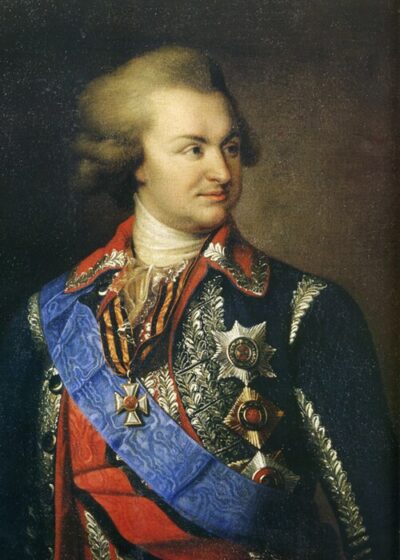
Gregory Potyomkin
Gregory Potyomkin was a Russian military leader and politician. Born September 13, 1739, in Chizhevo. Died October 5, 1791, in Rădenii Vechi. Educated at Moscow University Gymnasium and Imperial Moscow University. Awards include Knight of the Order of St. Alexander Nevsky, Order of the White Eagle and Order of the Black Eagle.
Facts
34 facts · 0 confirmed by two sources · 2 cited · 30 from one source · 2 where the sources disagree
What’s different
- Born: we show September 13, 1739 (Sources disagree). Wikipedia says October 11, 1739
- Died: we show October 5, 1791 (Sources disagree). Wikipedia says October 16, 1791
Where this comes from
Papalocal keeps its own record. It started from these sources; what each one said is kept here as it was copied, so a change on their side never changes this page by itself. Tap one to read its version.
What Wikidata says · copied November 16, 2026 · revision 2564321956
- Described as
- Russian military leader and politician (1739–1791)
- Other names
- Gregory Alexandrovich Potyomkin-Tavricheski, Potyomkin, Prince Gregory Alexandrovich Potyomkin-Tauricheski
- Born
- September 13, 1739 · 1 reference
- Died
- October 5, 1791 · 1 reference
- Born in
- Chizhevo
- Died in
- Rădenii Vechi
- Buried in
- St. Catherine's Cathedral, Kherson
- Citizen of
- Russian Empire
- Occupation
- linguist; military personnel; politician · 1 reference; military leader · 1 reference
- Education
- Moscow University Gymnasium (1756–1760) · 1 reference; Imperial Moscow University
- Awards
- Knight of the Order of St. Alexander Nevsky (1774); Order of the White Eagle; Order of the Black Eagle; Order of Saint Anna (1770); Order of St. George, 3rd class (1770); Order of St. Andrew (1774); Order of St. George, 2nd class (1775); Order of St. George, 1st class (1788); Order of Saint Stanislaus; Knight of the Order of the Elephant (1776); Knight of the Seraphim (1776); Order of St. Vladimir, 1st class (1782); Gold Sword for Bravery (1774)
- Children
- Elizabeth Grigoryevna Temkina
- Father
- Alexander Potemkin
- Mother
- Darya Kondyreva
- Siblings
- Yelena Potyomkina · 1 reference
- Religion
- Russian Orthodox Church
- Military branch
- cavalry
- Military rank
- Corporal (1757–) · 1 reference; general field marshal (1784–) · 1 reference; adjutant general · 1 reference
- Wikipedias with a page
- 59
Wikidata item Q243201 (wikidata.org/wiki/Q243201), public domain (CC0). Copied November 16, 2026.
What Wikipedia says · copied November 16, 2026 · revision 1384860429
Prince Grigory Aleksandrovich Potemkin-Tauricheski (11 October [O.S. 30 September] 1739 – 16 October [O.S. 5 October] 1791) was a Russian Imperial statesman who rose to prominence as a favourite and, according to a widely supported theory, the morganatic spouse of Catherine the Great.
Potemkin was born into a family of middle-income landowners of Russian nobility. He first attracted Catherine's favor for helping in her 1762 coup, then distinguished himself as a military commander in the Russo-Turkish War (1768–1774). He became Catherine's lover, favorite and possibly her consort. After their passion cooled, he remained her lifelong friend and favored statesman. Catherine obtained for him the title of Prince of the Holy Roman Empire and gave him the title of Prince of the Russian Empire among many others; he was both a Grand Admiral and the head of all of Russia's land and irregular forces. Potemkin's achievements include the peaceful annexation of the Crimea (1783) and the successful second Russo-Turkish War (1787–1792), during which the armed forces under his command besieged Ochakov. He died during negotiations over the Treaty of Iași, which ended a war with the Ottoman Empire that he had overseen.
In 1775, Potemkin became the governor-general of Russia's new southern provinces. An absolute ruler, he worked to colonize the wild steppes, controversially dealing firmly with the Cossacks who lived there. He founded the towns of Kherson, Nikolayev, Sevastopol, and Yekaterinoslav. Ports in the region became bases for his new Black Sea Fleet.
His rule in the south is associated with the (probably mythical) "Potemkin village", a ruse involving the construction of painted façades to mimic real villages, full of happy, well-fed people, for visiting officials to see. Potemkin was known for his love of women, gambling, and material wealth. He oversaw the construction of many historically significant buildings, including the Tauride Palace in Saint Petersburg.
- Born, in its opening lines
- October 11, 1739
- Died, in its opening lines
- October 16, 1791
From the Wikipedia article “Grigory Potemkin” (en.wikipedia.org/wiki/Grigory_Potemkin), by its contributors, under CC BY-SA 4.0 (creativecommons.org/licenses/by-sa/4.0/). Copied November 16, 2026; not changed.
Confirmed Two sources agree. Cited One source, and it names where it got it. One source One source, without a reference of its own. Sources disagree The sources disagree. We show the best-supported value and keep theirs below.
