
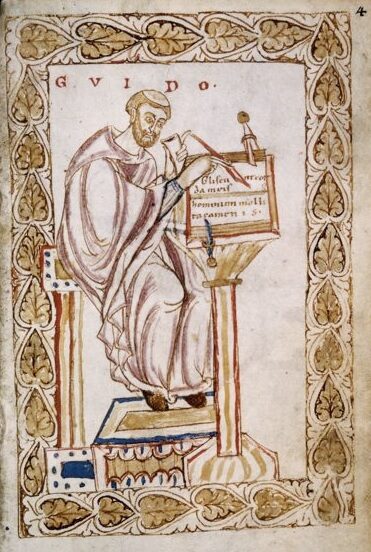
Guido of Arezzo
Guido of Arezzo was the 11th century Italian monk, inventor of modern musical notation. Born 992, in Arezzo. Died 1050, in Arezzo.
Facts
11 facts · 0 confirmed by two sources · 4 cited · 4 from one source · 3 where the sources disagree
What’s different
- Born: we show 992 (Sources disagree). Wikipedia says 991
- Died: we show 1050 (Sources disagree). Wikipedia says 992
- Born in: we show Arezzo (Sources disagree). Wikidata also lists Abbazia di Pomposa
Where this comes from
Papalocal keeps its own record. It started from these sources; what each one said is kept here as it was copied, so a change on their side never changes this page by itself. Tap one to read its version.
What Wikidata says · copied November 16, 2026 · revision 2557900397
- Described as
- 11th century Italian monk, inventor of modern musical notation
- Other names
- Guido d'Arezzo, Guido Aretinus, Guido da Arezzo
- Born
- 992 · 2 references
- Died
- 1050 · 5 references
- Born in
- Arezzo · 1 reference; Abbazia di Pomposa
- Died in
- Arezzo
- Occupation
- music theorist · 1 reference; musicologist · 1 reference; inventor; writer · 1 reference; monk · 2 references; teacher · 1 reference
- Field
- music
- Wikipedias with a page
- 63
Wikidata item Q192238 (wikidata.org/wiki/Q192238), public domain (CC0). Copied November 16, 2026.
What Wikipedia says · copied November 16, 2026 · revision 1369748442
Guido of Arezzo (Italian: Guido d'Arezzo; c. 991–992 – after 1033) was an Italian music theorist and pedagogue of High medieval music. A monk from the Order of Saint Benedict, he is regarded as the inventor—or by some, developer—of the modern staff notation that had a massive influence on the development of Western musical notation and practice. Perhaps the most significant European writer on music between Boethius and Johannes Tinctoris, Guido wrote the Micrologus, the most widely distributed medieval treatise on music, after Boethius's De institutione musica.
Biographical information on Guido is only available from two contemporary documents; though they give limited background, a basic understanding of his life can be unravelled. By around 1013 he began teaching at Pomposa Abbey, but his antiphonary Prologus in antiphonarium and novel teaching methods based on staff notation brought considerable resentment from his colleagues. He thus moved to Arezzo in 1025 and under the patronage of Bishop Tedald of Arezzo he taught singers at the Arezzo Cathedral. Using staff notation, he was able to teach large amounts of music quickly, and he wrote the multifaceted Micrologus, attracting attention from around Italy. Interested in his innovations, Pope John XIX called him to Rome. After arriving and beginning to explain his methods to the clergy, sickness sent him away in the summer. The rest of his life is largely unknown, but he settled in a monastery near Arezzo, probably one of the Avellana of the Camaldolese order.
- Born, in its opening lines
- 991
- Died, in its opening lines
- 992
From the Wikipedia article “Guido of Arezzo” (en.wikipedia.org/wiki/Guido_of_Arezzo), by its contributors, under CC BY-SA 4.0 (creativecommons.org/licenses/by-sa/4.0/). Copied November 16, 2026; not changed.
Confirmed Two sources agree. Cited One source, and it names where it got it. One source One source, without a reference of its own. Sources disagree The sources disagree. We show the best-supported value and keep theirs below.
