
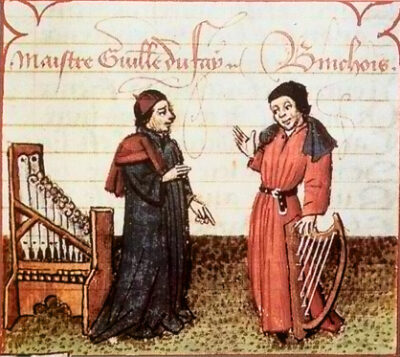
Guillaume Dufay
Guillaume Dufay was a composer of the Renaissance. Born August 13, 1397, in Beersel. Died November 27, 1474, in Cambrai. Known for Missa Se la face ay pale, Missa L'Homme armé and Vassilissa Ergo Gaude.
Facts
21 facts · 1 confirmed by two sources · 5 cited · 14 from one source · 1 where the sources disagree
What’s different
- Born: we show August 13, 1397 (Sources disagree). Wikipedia says August 5, 1397
Where this comes from
Papalocal keeps its own record. It started from these sources; what each one said is kept here as it was copied, so a change on their side never changes this page by itself. Tap one to read its version.
What Wikidata says · copied November 16, 2026 · revision 2563761194
- Described as
- composer of the Renaissance (1397–1474)
- Other names
- Guillaume Du Fay
- Born
- August 13, 1397
- Died
- November 27, 1474 · 5 references
- Born in
- Beersel · 1 reference
- Died in
- Cambrai · 2 references
- Citizen of
- Kingdom of France
- Occupation
- composer · 1 reference; music theorist
- Genre
- polyphony; classical music
- Known for
- Missa Se la face ay pale; Missa L'Homme armé; Vassilissa Ergo Gaude; Nuper rosarum flores; Lamentatio sanctae matris ecclesiae Constantinopolitanae; Dieu gard la dame sans reprise; Resistera; Mon seul plaisir, ma doulce joie; Belle vueillés; Vostre bruit et vostre grant fame
- Field
- music · 1 reference; music theory · 1 reference
- Wikipedias with a page
- 57
Wikidata item Q207717 (wikidata.org/wiki/Q207717), public domain (CC0). Copied November 16, 2026.
What Wikipedia says · copied November 16, 2026 · revision 1360681095
Guillaume Du Fay ( dyoo-FEYE, French: [ɡijom dy fa(j)i]; also Dufay, Du Fayt; 5 August 1397 – 27 November 1474) was a composer and music theorist of early Renaissance music, who is variously described as French or Franco-Flemish. Considered the leading European composer of his time, his music was widely performed and reproduced. Du Fay was well-associated with composers of the Burgundian School, particularly his colleague Gilles Binchois, but was never a regular member of the Burgundian chapel himself.
While he is among the best-documented composers of his time, Du Fay's birth and family are shrouded with uncertainty, though he was probably the illegitimate child of a priest. He was educated at Cambrai Cathedral, where his teachers included Nicolas Grenon and Richard Loqueville. For the next decade, Du Fay worked throughout Europe: as a subdeacon in Cambrai, under Carlo I Malatesta in Rimini, for the House of Malatesta in Pesaro, and under Louis Aleman in Bologna, where he was ordained priest. As his fame began to spread, he settled in Rome in 1428 as musician of the prestigious papal choir, first under Pope Martin V and then Pope Eugene IV, where he wrote the motets Balsamus et munda cera, Ecclesie militantis and Supremum est mortalibus. Amid Rome's financial and political disorder in the 1430s, Du Fay took a leave of absence from the choir to serve Amadeus VIII, Duke of Savoy.
Du Fay returned to Italy in 1436, writing his most admired work, the complex motet Nuper Rosarum Flores, which celebrated the consecration of Filippo Brunelleschi's dome for the Florence Cathedral. He later joined the recently moved papal court in Bologna, and was associated with the House of Este in Ferrara. For the next eleven years, Du Fay was in Cambrai serving Philip the Good, under whom he may have written now-lost works on music theory. After a brief return to both Savoy and Italy, Du Fay settled in Cambrai in 1458, where his focus shifted from song and motet, to composing English-inspired cyclic masses based on cantus firmus, such as the Missa Ave regina celorum, the Missa Ecce ancilla Domini, the Missa L'Homme armé and the Missa Se la face ay pale. During his final years in Cambrai, Du Fay wrote his now-lost requiem and both met and influenced the leading musicians of his time, including Antoine Busnois, Loyset Compère, Johannes Tinctoris and particularly, Johannes Ockeghem.
Du Fay has been described as leading the first generation of European musicians who were primarily considered 'composers' by occupation. His erratic career took him throughout Western Europe, resulting in a 'cosmopolitan style' and an extensive oeuvre which included representatives of virtually every polyphonic genre of his time. Like Binchois, Du Fay was deeply influenced by the contenance angloise style of John Dunstaple, and synthesized it with a wide variety of other styles, including that of the famous Missa Caput, and the techniques of his younger contemporaries, Ockeghem and Busnois.
- Born, in its opening lines
- August 5, 1397
- Died, in its opening lines
- November 27, 1474
From the Wikipedia article “Guillaume Du Fay” (en.wikipedia.org/wiki/Guillaume_Du_Fay), by its contributors, under CC BY-SA 4.0 (creativecommons.org/licenses/by-sa/4.0/). Copied November 16, 2026; not changed.
Confirmed Two sources agree. Cited One source, and it names where it got it. One source One source, without a reference of its own. Sources disagree The sources disagree. We show the best-supported value and keep theirs below.
