
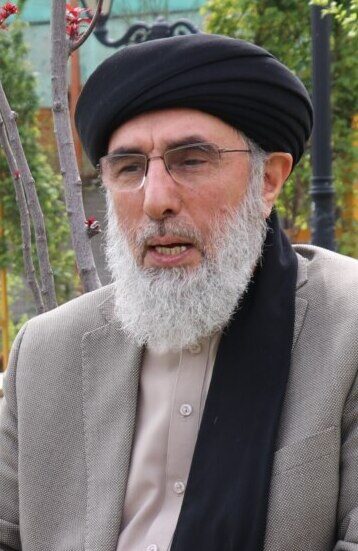
Gulbuddin Hekmatyar
Gulbuddin Hekmatyar is an Afghan politician, mujahid and drug trafficker. Born August 1, 1949, in Imam Sahib District. Positions held include Prime Minister of Afghanistan. Educated at Kabul University.
Facts
11 facts · 1 confirmed by two sources · 0 cited · 10 from one source
Where this comes from
Papalocal keeps its own record. It started from these sources; what each one said is kept here as it was copied, so a change on their side never changes this page by itself. Tap one to read its version.
What Wikidata says · copied November 16, 2026 · revision 2562799486
- Described as
- Afghan politician, mujahid and drug trafficker (born 1949)
- Other names
- Hekmatyar
- Born
- August 1, 1949 · 1 reference
- Born in
- Imam Sahib District
- Citizen of
- Afghanistan
- Occupation
- politician; military leader
- Positions held
- Prime Minister of Afghanistan
- Political party
- Hezb-e Islami Gulbuddin; Hezbe Islami · 1 reference
- Education
- Kabul University
- Religion
- Islam
- Military rank
- commander-in-chief · 1 reference
- Wikipedias with a page
- 44
Wikidata item Q317797 (wikidata.org/wiki/Q317797), public domain (CC0). Copied November 16, 2026.
What Wikipedia says · copied November 16, 2026 · revision 1386086301
Gulbuddin Hekmatyar (born 1 August 1949) is an Afghan politician, and former mujahideen commander and drug trafficker. He is the founder and current leader of the Hizb-i-Islami Afghanistan political party. He twice served as prime minister during the 1990s.
Born to a Ghilzai Pashtun family, Hekmatyar joined the Muslim Youth organization as a student in the early 1970s, where he was known for his Islamic radicalism rejected by much of the organization. He spent time in Pakistan before returning to Afghanistan when the Soviet–Afghan War began in 1979, at which time the CIA began funding his rapidly growing Hezb-e Islami organization through the Pakistani intelligence service, Inter-Services Intelligence. It was the largest of the Afghan mujahideen and Hekmatyar received more CIA funding than any other mujahideen leader during the Soviet-Afghan War.
In the late 1980s, Hekmatyar and his organization used the funds and weapons provided to them by the CIA to start trafficking opium, and later moved into manufacturing heroin. He established himself and his group amongst the leading heroin suppliers in the Middle East. Given the CIA's connection, this became a subject of diplomatic embarrassment for the US foreign service. Following the ouster of Soviet-backed Afghan President Mohammad Najibullah in 1992, Hekmatyar declined to form part of the Islamic State of Afghanistan and, with other warlords, engaged in the Afghan Civil War, leading to the death of around 50,000 civilians in Kabul alone. Hekmatyar was accused of bearing the most responsibility for the rocket attacks on the city. In the meantime, as part of the peace and power-sharing efforts led by Ahmad Shah Massoud, Hekmatyar became Prime Minister of Afghanistan from 1993 to 1994 and again briefly in 1996, before the Taliban takeover of Kabul forced him to flee to Iran's capital Tehran.
Sometime after the Taliban's fall in 2001 he went to Pakistan, leading his paramilitary forces into an unsuccessful armed campaign against Hamid Karzai's government and the international coalition in Afghanistan. In 2016, he signed a peace deal with the Afghan government and was allowed to return to Afghanistan after almost 20 years in exile.
Following the collapse of the Islamic Republic of Afghanistan, on 17 August 2021, Hekmatyar met with both Karzai and Abdullah Abdullah, former chairman of the High Council for National Reconciliation and former chief executive, in Doha, seeking to form a government. However, they were subdued as the Taliban formed a non-inclusive government in September 2021. Hekmatyar remained in Afghanistan under Taliban restrictions until going to Malaysia for medical treatment in December 2025.
- Born, in its opening lines
- August 1, 1949
From the Wikipedia article “Gulbuddin Hekmatyar” (en.wikipedia.org/wiki/Gulbuddin_Hekmatyar), by its contributors, under CC BY-SA 4.0 (creativecommons.org/licenses/by-sa/4.0/). Copied November 16, 2026; not changed.
Confirmed Two sources agree. Cited One source, and it names where it got it. One source One source, without a reference of its own. Sources disagree The sources disagree. We show the best-supported value and keep theirs below.
