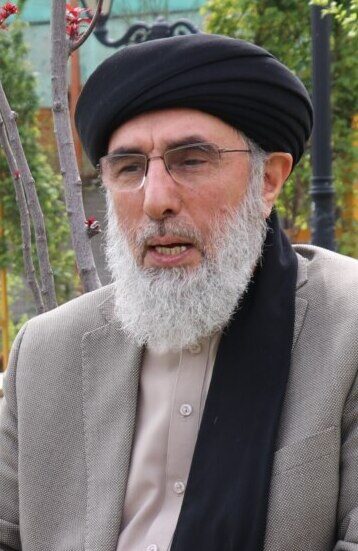
Hezb-e Islami Gulbuddin
Hezb-e Islami Gulbuddin is a primarily Pashtun Afghan political party and former militia. It was founded in 1975 by Gulbuddin Hekmatyar. It stands for Islamism and Islamic fundamentalism.
- Country
- Afghanistan
- Founded
- 1975
- Ideology
- Islamism
All 9 facts, and where they come from
Facts
9 facts · 0 confirmed by two sources · 2 cited · 7 from one source
Where this comes from
Papalocal keeps its own record. It started from these sources; what each one said is kept here as it was copied, so a change on their side never changes this page by itself. Tap one to read its version.
What Wikidata says · copied November 17, 2026 · revision 2554094125
- Described as
- primarily Pashtun Afghan political party and former militia
- Other names
- Hezb-i-Islami Afghanistan, Islamic Party, Hezbe Islami Gulbuddin
- What it is
- political party; militia (1975–2016); terrorist organization (–2016) · 1 reference
- Comes after
- Hezbe Islami
- Founded
- 1975
- Founded by
- Gulbuddin Hekmatyar
- Country
- Afghanistan
- Ideology
- Islamism · 1 reference; Islamic fundamentalism
- Wikipedias with a page
- 18
Wikidata item Q3135107 (wikidata.org/wiki/Q3135107), public domain (CC0). Copied 2026-11-17.
What Wikipedia says · copied November 17, 2026 · revision 1382268896
Hezb-e-Islami Gulbuddin (Pashto: حزب اسلامی گلبدین; abbreviated HIG), also referred to as Hezb-e-Islami or Hezb-i-Islami Afghanistan (HIA), is an Afghan political party and former paramilitary organization, originally founded in 1976 as Hezb-e-Islami and led by Gulbuddin Hekmatyar. In 1979, Mulavi Younas Khalis split with Hekmatyar and established his own group, which became known as Hezb-i Islami Khalis; the remaining part of Hezb-e Islami, still headed by Hekmatyar, became known as Hezb-e Islami Gulbuddin. Hezbi Islami seeks to emulate the Muslim Brotherhood and to replace the various tribal factions of Afghanistan with one unified Islamic state. This puts them at odds with the more tribe-oriented Taliban (which is predominantly Pashtun).
During the Soviet War in Afghanistan (1979–1989), Hezb-e Islami Gulbuddin was well-financed by anti-Soviet forces through the Pakistani Inter-Services Intelligence (ISI). In the mid-1990s, the HIG was "sidelined from Afghan politics" by the rise of the Taliban. In the post-2001 war in Afghanistan, HIG "reemerged as an aggressive militant group, claiming responsibility for many bloody attacks against Coalition forces and the administration of President Hamid Karzai". Its fighting strength was "sometimes estimated to number in the thousands". The group signed a peace deal with the Ghani administration in 2016.
Following the collapse of the Islamic Republic of Afghanistan, on 17 August 2021, Hekmatyar met with both Karzai, former President of Afghanistan, and Abdullah Abdullah, Chairman of the High Council for National Reconciliation and former Chief Executive, in Doha seeking to form a government (though it was unclear whether either Karzai or Abdullah would be directly involved in any such government). President Ashraf Ghani, having fled the country to either Tajikistan or Uzbekistan, emerged in the UAE and said that he supported such negotiations and was in talks to return to Afghanistan.
From the Wikipedia article “Hizb-i-Islami Afghanistan” (en.wikipedia.org/wiki/Hizb-i-Islami_Afghanistan), by its contributors, under CC BY-SA 4.0 (creativecommons.org/licenses/by-sa/4.0/). Copied 2026-11-17; not changed.
Confirmed Two sources agree. Cited One source, and it names where it got it. One source One source, without a reference of its own. Sources disagree The sources disagree. We show the best-supported value and keep theirs below.