
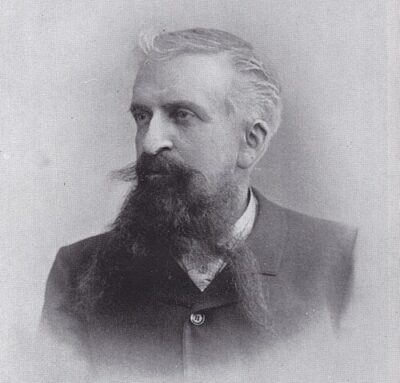
Gustave Le Bon
Gustave Le Bon was a French psychologist. Born May 7, 1841, in Nogent-le-Rotrou. Died December 13, 1931, in Paris. Positions held include director (1902–1931). Known for The Crowd: A Study of the Popular Mind. Educated at Paris Medical Faculty and University of Paris. Awards include Grand Officer of the Legion of Honour and Godard Prize.
Facts
21 facts · 2 confirmed by two sources · 7 cited · 12 from one source
Where this comes from
Papalocal keeps its own record. It started from these sources; what each one said is kept here as it was copied, so a change on their side never changes this page by itself. Tap one to read its version.
What Wikidata says · copied November 16, 2026 · revision 2522921273
- Described as
- French psychologist (1841-1931)
- Born
- May 7, 1841 · 6 references
- Died
- December 13, 1931 · 1 reference
- Born in
- Nogent-le-Rotrou · 1 reference
- Died in
- Paris · 1 reference
- Buried in
- Père Lachaise Cemetery
- Name at birth
- Charles Marie Gustave Le Bon
- Citizen of
- France
- Occupation
- physician; anthropologist; psychologist · 1 reference; sociologist · 1 reference; physicist · 1 reference; ethnologist · 1 reference; philosopher · 1 reference
- Positions held
- director (1902–1931)
- Education
- Paris Medical Faculty; University of Paris · 1 reference
- Member of
- Society of Anthropology of Paris
- Known for
- The Crowd: A Study of the Popular Mind
- Awards
- Grand Officer of the Legion of Honour (1929); Godard Prize (1879) · 1 reference
- Wikipedias with a page
- 85
Wikidata item Q294572 (wikidata.org/wiki/Q294572), public domain (CC0). Copied November 16, 2026.
What Wikipedia says · copied November 16, 2026 · revision 1376548277
Charles-Marie Gustave Le Bon (7 May 1841 – 13 December 1931) was a leading French polymath whose areas of interest included anthropology, psychology, sociology, medicine, invention, and physics. He is best known for his 1895 work The Crowd: A Study of the Popular Mind, which is considered one of the seminal works of crowd psychology.
A native of Nogent-le-Rotrou, Le Bon qualified as a doctor of medicine at the University of Paris in 1866. He opted against the formal practice of medicine as a physician, instead beginning his writing career the same year of his graduation. He published a number of medical articles and books before joining the French Army after the outbreak of the Franco-Prussian War. Defeat in the war coupled with being a first-hand witness to the Paris Commune of 1871 strongly shaped Le Bon's worldview. He then travelled widely, touring Europe, Asia and North Africa. He analysed the peoples and the civilisations he encountered under the umbrella of the nascent field of anthropology, developing an essentialist view of humanity, and invented a portable cephalometer during his travels.
In the 1890s, he turned to psychology and sociology, in which fields he released his most successful works. Le Bon developed the view that crowds are not the sum of their individual parts, proposing that within crowds there forms a new psychological entity, the characteristics of which are determined by the "racial unconscious" of the crowd. At the same time he created his psychological and sociological theories, he performed experiments in physics and published popular books on the subject, anticipating the mass–energy equivalence and prophesising the Atomic Age. Le Bon maintained his eclectic interests up until his death in 1931.
Ignored or maligned by sections of the French academic and scientific establishment during his life due to his politically conservative and reactionary views, Le Bon was critical of majoritarianism and socialism.
- Born, in its opening lines
- May 7, 1841
- Died, in its opening lines
- December 13, 1931
From the Wikipedia article “Gustave Le Bon” (en.wikipedia.org/wiki/Gustave_Le_Bon), by its contributors, under CC BY-SA 4.0 (creativecommons.org/licenses/by-sa/4.0/). Copied November 16, 2026; not changed.
Confirmed Two sources agree. Cited One source, and it names where it got it. One source One source, without a reference of its own. Sources disagree The sources disagree. We show the best-supported value and keep theirs below.
