
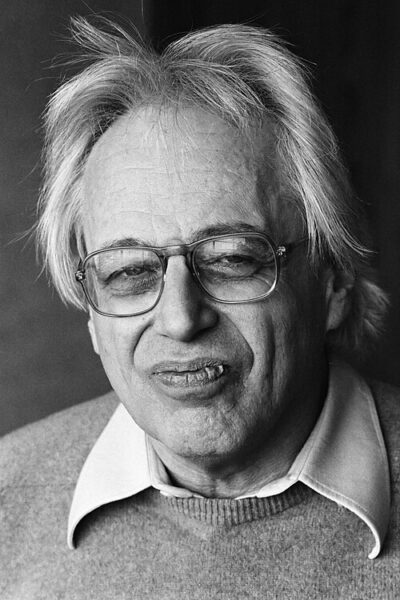
György Ligeti
György Ligeti was a Hungarian composer. Born May 28, 1923, in Târnăveni. Died June 12, 2006, in Vienna. Known for Poème symphonique. Educated at Franz Liszt Academy of Music. Awards include Kossuth Prize, Ring of Honour of the City of Vienna and Bach Prize of the Free and Hanseatic City of Hamburg.
Facts
46 facts · 2 confirmed by two sources · 11 cited · 33 from one source
Where this comes from
Papalocal keeps its own record. It started from these sources; what each one said is kept here as it was copied, so a change on their side never changes this page by itself. Tap one to read its version.
What Wikidata says · copied November 16, 2026 · revision 2565133603
- Described as
- Hungarian composer (1923-2006)
- Other names
- Gyorgy Ligeti, György Sándor Ligeti, Ligeti
- Born
- May 28, 1923 · 12 references
- Died
- June 12, 2006 · 9 references
- Born in
- Târnăveni · 1 reference
- Died in
- Vienna · 3 references
- Buried in
- Vienna Central Cemetery · 1 reference
- Name at birth
- Ligeti György Sándor
- Citizen of
- Hungary · 1 reference; Austria (1967–) · 1 reference
- Occupation
- composer · 2 references; music educator; university teacher; pianist; musician · 1 reference; librettist; illustrator · 1 reference; conductor · 1 reference
- Worked for
- Hamburg University of Music and Drama (1973–1989)
- Education
- Franz Liszt Academy of Music (1945–1951)
- Member of
- European Academy of Sciences and Arts; Romanian Academy; American Academy of Arts and Sciences; Bavarian Academy of Fine Arts; Académie des beaux-arts
- Genre
- opera
- Instrument
- piano
- Record label
- Deutsche Grammophon
- Known for
- Poème symphonique
- Awards
- Kossuth Prize (2003); Ring of Honour of the City of Vienna; Bach Prize of the Free and Hanseatic City of Hamburg (1975); Pour le Mérite for Sciences and Arts order; Theodor W. Adorno Award (2003); Balzan Prize (1991); Praemium Imperiale (1991) · 1 reference; Léonie Sonning Music Prize (1990); Rolf Schock Prize in Musical Arts (1995); Royal Philharmonic Society Gold Medal (2004) · 1 reference; Berliner Kunstpreis (1972); Grawemeyer Awards (1986); Goethe Medal (1990) · 1 reference; Wihuri Sibelius Prize (2000); City of Vienna Prize for Music (1993)
- Spouse
- Vera Ligeti
- Children
- Lukas Ligeti
- Father
- Sándor Ligeti
- Website
- http://www.gyoergy-ligeti.de · 1 reference
- Wikipedias with a page
- 56
Wikidata item Q154331 (wikidata.org/wiki/Q154331), public domain (CC0). Copied November 16, 2026.
What Wikipedia says · copied November 16, 2026 · revision 1376721984
György Sándor Ligeti ( ; Hungarian: [ˈliɡɛti ˈɟørɟ ˈʃaːndor]; 28 May 1923 – 12 June 2006) was a Hungarian composer of contemporary classical music. He has been described as "one of the most important avant-garde composers in the latter half of the twentieth century" and "one of the most innovative and influential among progressive figures of his time".
Born in Romania, he lived in the Hungarian People's Republic before emigrating to Austria in 1956. He became an Austrian citizen in 1968. In 1973 he became professor of composition at the Hochschule für Musik und Theater Hamburg, where he worked until retiring in 1989. His students included Hans Abrahamsen, Unsuk Chin and Michael Daugherty. He died in Vienna in 2006.
Restricted in his musical style by the authorities of Communist Hungary, only when he reached the West in 1956 could Ligeti fully realise his passion for avant-garde music and develop new compositional techniques. After experimenting with electronic music in Cologne, Germany, his breakthrough came with orchestral works such as Atmosphères, for which he used a technique he later dubbed micropolyphony. After writing his "anti-anti-opera" Le Grand Macabre, Ligeti shifted away from chromaticism and towards polyrhythm for his later works.
He is best known by the public through the use of his music in film soundtracks. Although he did not directly compose any film scores, excerpts of pieces composed by him were taken and adapted for film use. The sound design of Stanley Kubrick's films, particularly the music of 2001: A Space Odyssey, drew from Ligeti's work.
- Born, in its opening lines
- May 28, 1923
- Died, in its opening lines
- June 12, 2006
From the Wikipedia article “György Ligeti” (en.wikipedia.org/wiki/György_Ligeti), by its contributors, under CC BY-SA 4.0 (creativecommons.org/licenses/by-sa/4.0/). Copied November 16, 2026; not changed.
Confirmed Two sources agree. Cited One source, and it names where it got it. One source One source, without a reference of its own. Sources disagree The sources disagree. We show the best-supported value and keep theirs below.
