
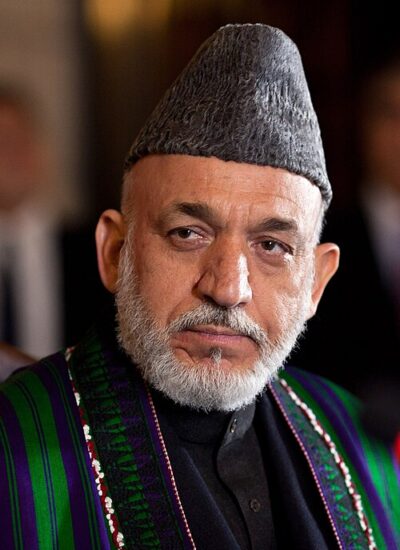
Hamid Karzai
Hamid Karzai is a President of Afghanistan from 2001 to 2014. Born December 24, 1957, in Karz. Positions held include President of Afghanistan (2004–2014). Educated at Himachal Pradesh University and Habibia High School. Awards include Knight Grand Cross of the Order of St Michael and St George, Indira Gandhi Peace Prize and Philadelphia Liberty Medal.
Facts
26 facts · 1 confirmed by two sources · 1 cited · 24 from one source
Where this comes from
Papalocal keeps its own record. It started from these sources; what each one said is kept here as it was copied, so a change on their side never changes this page by itself. Tap one to read its version.
What Wikidata says · copied November 16, 2026 · revision 2567074256
- Described as
- President of Afghanistan from 2001 to 2014
- Other names
- Karzai, Hamid Abd al-Ahad Karzai
- Born
- December 24, 1957 · 4 references
- Born in
- Karz
- Citizen of
- Kingdom of Afghanistan (1957–1973); Republic of Afghanistan (1973–1978); Democratic Republic of Afghanistan (1978–1992); Islamic State of Afghanistan (1992–2002)
- Occupation
- politician · 1 reference
- Positions held
- President of Afghanistan (2004–2014)
- Political party
- independent politician
- Education
- Himachal Pradesh University; Habibia High School (–1976); Middle East Technical University
- Awards
- Knight Grand Cross of the Order of St Michael and St George; Indira Gandhi Peace Prize (2005); Philadelphia Liberty Medal; Freedom Award (2002); Steiger Award; Golden Plate Award; Order of Saint Michael and Saint George · 1 reference
- Spouse
- Zeenat Karzai (1999–)
- Father
- Abdul Ahad Karzai
- Siblings
- Ahmed Wali Karzai; Mahmud Karzai; Qayum Karzai
- Religion
- Islam; Sunni Islam
- Wikipedias with a page
- 109
Wikidata item Q43944 (wikidata.org/wiki/Q43944), public domain (CC0). Copied November 16, 2026.
What Wikipedia says · copied November 16, 2026 · revision 1381702323
Hamid Karzai (born 24 December 1957) is a former Afghan politician who served as the seventh president of Afghanistan from 2002 to 2014, particularly as the first president of the Islamic Republic of Afghanistan from 2004 to 2014. He also served as chairman of the Afghan Interim Administration from 2001 to 2002.
Born in Kandahar, Karzai graduated from Habibia High School in Kabul and later received a master's degree from Himachal Pradesh University, Summerhill, Shimla, India, in the 1980s. He moved to Pakistan where he was active as a fundraiser for the Afghan mujahideen during the Soviet–Afghan War (1979–1989) and its aftermath. He briefly served as Deputy Foreign Minister in the Islamic State of Afghanistan government. In July 1999, Karzai's father was assassinated and Karzai succeeded him as head of the Popalzai tribe. In October 2001 the United States invasion of Afghanistan began and Karzai led the Pashtun tribes in and around Kandahar in an uprising against the Taliban; he became a dominant political figure after the removal of the Taliban regime in late 2001. During the December 2001 International Conference on Afghanistan in Germany, Karzai was selected by prominent Afghan political figures to serve a six-month term as chairman of the Interim Administration.
He was then chosen for a two-year term as interim president during the 2002 loya jirga (grand assembly) that was held in Kabul, Afghanistan. After the 2004 presidential election, Karzai was declared the winner and became President of Afghanistan. He won a second five-year term in the 2009 presidential election; this term ended in September 2014, and he was succeeded by Ashraf Ghani.
During his presidency, Karzai was known in the international community for being an alliance builder between Afghanistan's multi-ethnic communities. He also strengthened Afghanistan–Pakistan relations. In later years, his relationship with NATO and the United States became increasingly strained. Karzai's stance on extremism and terrorism was criticized. Karzai described the Taliban as his brothers, and warned that the heavy-handed counterinsurgency in Afghanistan would only revive the Taliban insurgency against the former Afghan government. Instead he urged the US to instead focus on subduing Pakistan's support for the Taliban leadership, but the US largely ignored his requests. Karzai was also accused of corruption.
After the Taliban takeover of Kabul in 2021, Karzai stated the Taliban did not capture the city by force, but rather were invited by him in order to prevent chaos. He said that in order to gain international recognition, the new Taliban government needed internal legitimacy, which could be achieved through a general election or loya jirga.
- Born, in its opening lines
- December 24, 1957
From the Wikipedia article “Hamid Karzai” (en.wikipedia.org/wiki/Hamid_Karzai), by its contributors, under CC BY-SA 4.0 (creativecommons.org/licenses/by-sa/4.0/). Copied November 16, 2026; not changed.
Confirmed Two sources agree. Cited One source, and it names where it got it. One source One source, without a reference of its own. Sources disagree The sources disagree. We show the best-supported value and keep theirs below.
