
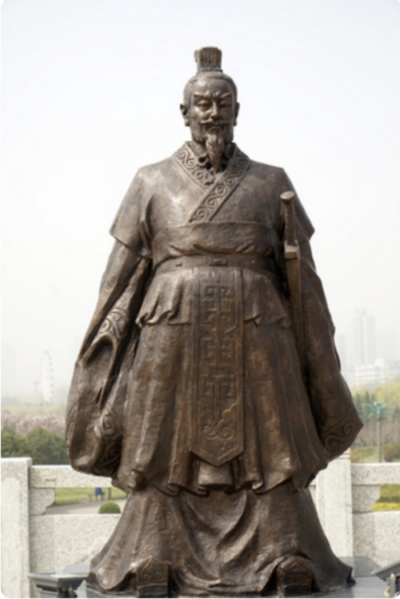
Han Fei
Han Fei was a Chinese Legalist, 280–233 BCE. Born 280 BC, in Xinzheng. Died 233 BC, in Xianyang County. Known for Han Feizi.
Facts
10 facts · 0 confirmed by two sources · 1 cited · 7 from one source · 2 where the sources disagree
What’s different
- Born: we show 280 BC (Sources disagree). Wikipedia says 280
- Died: we show 233 BC (Sources disagree). Wikipedia says 233
Where this comes from
Papalocal keeps its own record. It started from these sources; what each one said is kept here as it was copied, so a change on their side never changes this page by itself. Tap one to read its version.
What Wikidata says · copied November 16, 2026 · revision 2569086058
- Described as
- Chinese Legalist, 280–233 BCE
- Other names
- Han Feizi, Han Fei Zi, Master Han Fei, Master Han, Hanzi, Han-tsee, Hane-tsee
- Born
- 280 BC · 4 references
- Died
- 233 BC · 3 references
- Born in
- Xinzheng
- Died in
- Xianyang County
- Cause of death
- intoxication
- Citizen of
- Han
- Occupation
- philosopher · 1 reference; politician · 1 reference
- Known for
- Han Feizi
- Field
- philosophy
- Wikipedias with a page
- 74
Wikidata item Q28959 (wikidata.org/wiki/Q28959), public domain (CC0). Copied November 16, 2026.
What Wikipedia says · copied November 16, 2026 · revision 1384575120
Han Fei (c. 280 – 233 BC), also known as Han Feizi or Han Fei Tzu, was a Chinese Legalist philosopher and statesman during the Warring States period. He was an imperial clansman of the state of Han.
Han Fei is often considered the greatest representative of Legalism for the Han Feizi, a later anthology of writings traditionally attributed to him, which synthesized the methods of his predecessors. Han Fei's ideas are sometimes compared with those of Niccolò Machiavelli, author of The Prince. Zhuge Liang is said to have attached great importance to the Han Feizi.
After the early demise of the Qin dynasty, the Legalist school was officially vilified by the Han dynasty that succeeded it. Despite its outcast status throughout the history of imperial China, Han Fei's political theory and Legalist ideas continued to heavily influence every dynasty thereafter, and the Confucian ideal of rule without laws was never to be realized.
Han Fei borrowed Shang Yang's emphasis on laws, Shen Buhai's emphasis on administrative technique, and Shen Dao's ideas on authority and prophecy, emphasizing that the autocrat will be able to achieve firm control over the state with the mastering of his predecessors' methodologies: his position of 'power' (勢 shì), 'technique' (術 shù), and 'law' (fa). He stressed the importance of the concept of holding actual outcome accountable to speech (刑名 xingming), coupled with the "two handles" system of punishment and reward, as well as wu wei ('non-exertion').
- Born, in its opening lines
- 280
- Died, in its opening lines
- 233
From the Wikipedia article “Han Fei” (en.wikipedia.org/wiki/Han_Fei), by its contributors, under CC BY-SA 4.0 (creativecommons.org/licenses/by-sa/4.0/). Copied November 16, 2026; not changed.
Confirmed Two sources agree. Cited One source, and it names where it got it. One source One source, without a reference of its own. Sources disagree The sources disagree. We show the best-supported value and keep theirs below.
