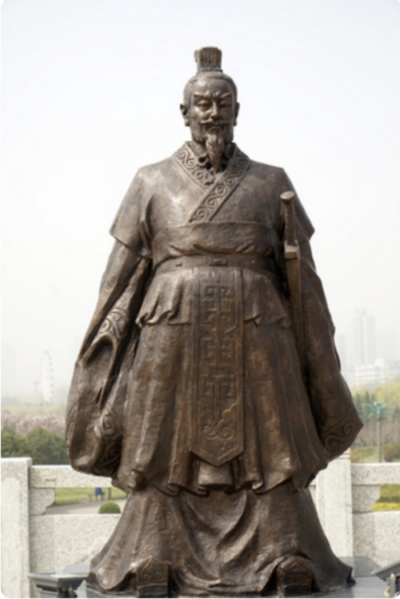
Han Feizi
Han Feizi is a 3rd-century BCE Chinese Legalist text.
- Published
- 3rd century BC
- Written by
- Han Fei
- Country of origin
- Han
All 5 facts, and where they come from
Facts
5 facts · 0 confirmed by two sources · 0 cited · 5 from one source
Where this comes from
Papalocal keeps its own record. It started from these sources; what each one said is kept here as it was copied, so a change on their side never changes this page by itself. Tap one to read its version.
What Wikidata says · copied November 17, 2026 · revision 2537296555
- Described as
- 3rd-century BCE Chinese Legalist text
- Other names
- DZ 1177
- What it is
- literary work
- Written by
- Han Fei
- Published
- 3rd century BC
- Language
- Traditional Chinese
- Country of origin
- Han · 1 reference
- Wikipedias with a page
- 17
Wikidata item Q1075382 (wikidata.org/wiki/Q1075382), public domain (CC0). Copied 2026-11-17.
What Wikipedia says · copied November 17, 2026 · revision 1384231191
The Han Feizi (simplified Chinese: 韩非子; traditional Chinese: 韓非子; pinyin: Hánfēizi; lit. 'Book of Master Han Fei') is an ancient Chinese text attributed to the Legalist political philosopher Han Fei. It comprises a selection of essays in the Legalist tradition, elucidating theories of state power, and synthesizing the methodologies of his predecessors. Its 55 chapters, most of which date to the Warring States period mid-3rd century BCE, are the only such text to survive fully intact. The Han Feizi is believed to contain the first commentaries on the Dao De Jing. Traditionally associated with the Qin dynasty, succeeding emperors and reformers were still influenced by Shen Buhai and the Han Feizi, with Shang Yang's current again coming to prominence in the time of Emperor Wu.
Often considered the "culminating" or "greatest" Legalist texts, Han Fei was dubbed by A. C. Graham amongst as the "great synthesizer" of 'Legalism'". Sun Tzu's The Art of War incorporates both a Daoist philosophy of inaction and impartiality, and a 'Legalist' system of punishment and rewards, recalling Han Fei's use of the concepts of power and technique.
Among the most important philosophical classics in ancient China, it touches on administration, diplomacy, war and economics, and is also valuable for its abundance of anecdotes about pre-Qin China. Though differing considerably in style, the coherency of the essays lend themselves to the possibility that much was written by Han Fei himself, and are generally considered more philosophically engaging than the Book of Lord Shang. Zhuge Liang is said to have attached great importance to the Han Feizi, as well as to Han Fei's predecessor Shen Buhai.
From the Wikipedia article “Han Feizi” (en.wikipedia.org/wiki/Han_Feizi), by its contributors, under CC BY-SA 4.0 (creativecommons.org/licenses/by-sa/4.0/). Copied 2026-11-17; not changed.
Confirmed Two sources agree. Cited One source, and it names where it got it. One source One source, without a reference of its own. Sources disagree The sources disagree. We show the best-supported value and keep theirs below.
Picture: Wikimedia Commons: Hanfeizi or Han Feizi, Qing dynasty, Hunan Museum.jpg · See Commons file page