
Hans Hofmann
Hans Hofmann was a German-American painter. Born March 21, 1880, in Weißenburg in Bayern. Died February 17, 1966, in New York City. Educated at Académie Colarossi.
Facts
24 facts · 2 confirmed by two sources · 11 cited · 10 from one source · 1 where the sources disagree
What’s different
- Born in: we show Weißenburg in Bayern (Sources disagree). Wikidata also lists Weißenberg
Where this comes from
Papalocal keeps its own record. It started from these sources; what each one said is kept here as it was copied, so a change on their side never changes this page by itself. Tap one to read its version.
What Wikidata says · copied November 15, 2026 · revision 2563082465
- Described as
- German-American painter (1880–1966)
- Other names
- Hans Georg Albert Hofmann, Johann Georg Albert Hofmann, Johann Hofmann, Hans Hoffman, Hofmann
- Born
- March 21, 1880 · 11 references
- Died
- February 17, 1966 · 8 references
- Born in
- Weißenburg in Bayern · 1 reference; Weißenberg · 1 reference
- Died in
- New York City · 4 references
- Buried in
- Snow Cemetery · 1 reference
- Citizen of
- Germany · 1 reference; United States · 1 reference
- Occupation
- painter · 3 references; draftsperson · 1 reference; architect · 1 reference; pedagogue · 1 reference; art educator · 1 reference
- Worked for
- University of California, Berkeley
- Education
- Académie Colarossi
- Member of
- American Academy of Arts and Letters; The 8th Street Club
- Genre
- abstract art · 1 reference
- Field
- painting · 1 reference; abstract art · 1 reference; abstract expressionism · 1 reference; painting · 1 reference; visual art education · 1 reference
- Spouse
- Renate Hofmann · 1 reference; Maria Wolfegg Hofmann · 1 reference
- Wikipedias with a page
- 26
Wikidata item Q215461 (wikidata.org/wiki/Q215461), public domain (CC0). Copied November 15, 2026.
What Wikipedia says · copied November 15, 2026 · revision 1383615103
Hans Hofmann (March 21, 1880 – February 17, 1966) was a German-born American painter, renowned as both an artist and teacher. His career spanned two generations and two continents, and is considered to have both preceded and influenced Abstract Expressionism. Born and educated near Munich, he was active in the early twentieth-century European avant-garde and brought a deep understanding and synthesis of Symbolism, Neo-impressionism, Fauvism, and Cubism when he emigrated to the United States in 1932. Hofmann's painting is characterized by its rigorous concern with pictorial structure and unity, spatial illusionism, and use of bold color for expressive means. The influential critic Clement Greenberg considered Hofmann's first New York solo show at Peggy Guggenheim’s Art of This Century in 1944 (along with Jackson Pollock’s in late 1943) as a breakthrough in painterly versus geometric abstraction that heralded abstract expressionism. In the decade that followed, Hofmann's recognition grew through numerous exhibitions, notably at the Kootz Gallery, culminating in major retrospectives at the Whitney Museum of American Art (1957) and Museum of Modern Art (1963), which traveled to venues throughout the United States, South America, and Europe. His works are in the permanent collections of major museums around the world, including the Metropolitan Museum of Art, Tate Modern, Germanisches Nationalmuseum, National Gallery of Art, and Art Institute of Chicago.
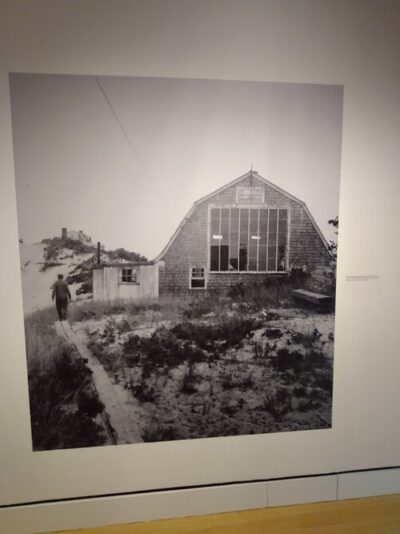
Hofmann is also regarded as one of the most influential art teachers of the 20th century. He established an art school in Munich in 1915 that built on the ideas and work of Cézanne, the Cubists and Kandinsky; some art historians suggest it was the first modern school of art anywhere. After relocating to the United States, he reopened the school in both New York City and Provincetown, Massachusetts until he retired from teaching in 1958 to paint full-time. His presence in New York teaching had a significant influence on post-war American avant-garde artists—including Joseph Glasco, Helen Frankenthaler, Nell Blaine, Lee Krasner, Joan Mitchell, Louise Nevelson, and Larry Rivers, among many others—as well as on the theories of Greenberg, in his emphasis on the medium, picture plane, and unity of the work. Some of Hofmann's other key tenets include his push/pull spatial theories, his insistence that abstract art has its origin in nature, and his belief in the spiritual value of art. Hofmann died of a heart attack at 85 in New York City on February 17, 1966.
- Born, in its opening lines
- March 21, 1880
- Died, in its opening lines
- February 17, 1966
From the Wikipedia article “Hans Hofmann” (en.wikipedia.org/wiki/Hans_Hofmann), by its contributors, under CC BY-SA 4.0 (creativecommons.org/licenses/by-sa/4.0/). Copied November 15, 2026; not changed.
Confirmed Two sources agree. Cited One source, and it names where it got it. One source One source, without a reference of its own. Sources disagree The sources disagree. We show the best-supported value and keep theirs below.
