
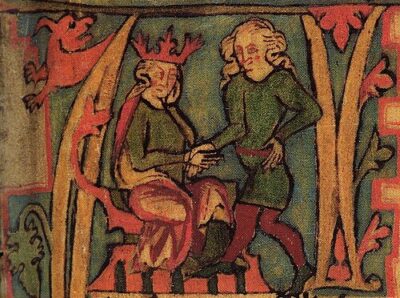
Harald Fairhair
Harald Fairhair was a King of Norway. Born 851, in Vestfold. Died 933, in Rogaland. Positions held include Monarch of Norway (924–930).
Facts
29 facts · 0 confirmed by two sources · 13 cited · 15 from one source · 1 where the sources disagree
What’s different
- Mother: we show Ragnhild Haraldsdatter (Sources disagree). Wikidata also lists Ragnhild Sigurdsdotter
Where this comes from
Papalocal keeps its own record. It started from these sources; what each one said is kept here as it was copied, so a change on their side never changes this page by itself. Tap one to read its version.
What Wikidata says · copied November 16, 2026 · revision 2565312022
- Described as
- King of Norway
- Other names
- Harold I of Norway, Harald the fairhaired, Haraldr Halfdanarson, Haraldr inn hárfagri, Haralld Harfagyr
- Born
- 851
- Died
- 933 · 1 reference
- Born in
- Vestfold
- Died in
- Rogaland
- Buried in
- Norway · 1 reference
- Citizen of
- Norway
- Occupation
- king · 1 reference
- Positions held
- Monarch of Norway (924–930)
- Spouse
- Gyda Eiriksdatter; Åsa Håkonsdatter; Svanhild Øysteinsdotter; Ragnhild Eiriksdatter; Åshild Ringsdatter; Snøfrid Svåsesdotter
- Children
- Eric Bloodaxe · 1 reference; Haakon the Good · 1 reference; Halfdan Haraldsson the Black · 1 reference; Bjørn Farmann; Olaf Haraldsson Geirstadalf · 1 reference; Halvdan Hålegg · 1 reference; Guttorm Haraldsson · 1 reference; Halfdan Hvide (?) · 1 reference; Sigrød Haraldsson · 1 reference; Ólöf árbót Haraldsdóttir · 1 reference; Rørek Haraldsson · 1 reference; Sigtrygg Haraldsson · 1 reference
- Father
- Halfdan the Black
- Mother
- Ragnhild Sigurdsdotter; Ragnhild Haraldsdatter · 1 reference
- Religion
- Old Norse religion
- Wikipedias with a page
- 53
Wikidata item Q206123 (wikidata.org/wiki/Q206123), public domain (CC0). Copied November 16, 2026.
What Wikipedia says · copied November 16, 2026 · revision 1385233417
Harald Fairhair (Old Norse: Haraldr Hárfagri; c. 850 – c. 932) was a Norwegian king. According to traditions current in Norway and Iceland in the eleventh and twelfth centuries, he reigned from c. 872 to 930 and was the first King of Norway. Supposedly, two of his sons, Eric Bloodaxe and Haakon the Good, succeeded Harald to become kings after his death.
Much of Harald's biography is uncertain. A couple of praise poems by his court poet Þorbjörn Hornklofi survive in fragments, but the extant accounts of his life come from sagas set down in writing around three centuries after his lifetime. His life is described in several of the Kings' sagas, none of them older than the twelfth century. Their accounts of Harald and his life differ on many points, but it is clear that in the twelfth and thirteenth centuries Harald was regarded as having unified Norway into one kingdom.
Since the nineteenth century, when Norway was in a personal union with Sweden, Harald has become a national icon of Norway and a symbol of independence. Though the king's sagas and medieval accounts have been critically scrutinised during the twentieth and early twenty-first centuries, Harald maintains a reputation as the father of the Norwegian nation. At the turn of the 21st century, a few historians have argued that Harald Fairhair did not exist as a historical figure.
From the Wikipedia article “Harald Fairhair” (en.wikipedia.org/wiki/Harald_Fairhair), by its contributors, under CC BY-SA 4.0 (creativecommons.org/licenses/by-sa/4.0/). Copied November 16, 2026; not changed.
Confirmed Two sources agree. Cited One source, and it names where it got it. One source One source, without a reference of its own. Sources disagree The sources disagree. We show the best-supported value and keep theirs below.
