
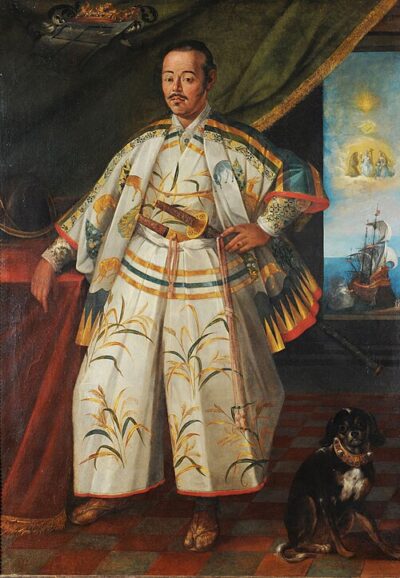
Hasekura Tsunenaga was a Japanese samurai and diplomat. Born 1571, in Nagai manor. Died August 7, 1622, in Mutsu Province.
Facts
13 facts · 2 confirmed by two sources · 2 cited · 9 from one source
Where this comes from
Papalocal keeps its own record. It started from these sources; what each one said is kept here as it was copied, so a change on their side never changes this page by itself. Tap one to read its version.
What Wikidata says · copied November 16, 2026 · revision 2521638393
- Described as
- Japanese samurai and diplomat
- Other names
- Philip Francis Faxicura, Felipe Francisco Faxicura, Philippus Franciscus Faxecura Rocuyemon, Hasekura Rokuemon Tsunenaga, Yamaguchi Yoichi
- Born
- 1571 · 4 references
- Died
- August 7, 1622
- Born in
- Nagai manor
- Died in
- Mutsu Province
- Buried in
- Mutsu Province
- Citizen of
- Japan
- Occupation
- diplomat · 1 reference; military personnel · 1 reference; explorer · 1 reference; samurai · 1 reference
- Field
- diplomat · 1 reference
- Father
- Yamaguchi Tsuneshige
- Religion
- Catholicism
- Wikipedias with a page
- 42
Wikidata item Q244764 (wikidata.org/wiki/Q244764), public domain (CC0). Copied November 16, 2026.
What Wikipedia says · copied November 16, 2026 · revision 1384755036
Hasekura Rokuemon Tsunenaga (支倉 六右衛門 常長; 1571–1622) was a kirishitan Japanese samurai and retainer of Date Masamune, the daimyō of Sendai. He was of Japanese imperial descent with ancestral ties to Emperor Kanmu. Other names include Philip Francis Faxicura, Felipe Francisco Faxicura, and Philippus Franciscus Faxecura Rocuyemon in period European sources, as he took a baptismal name upon converting to Catholicism.
In the years 1613 through 1620, Hasekura headed the Keichō Embassy (慶長使節), a diplomatic mission to Pope Paul V. He visited New Spain and various other ports-of-call in Europe on the way. On the return trip, Hasekura and his companions re-traced their route across New Spain in 1619, sailing from Acapulco for Manila, and then sailing north to Japan in 1620.
Although Hasekura's embassy was cordially received in Spain and Rome, it happened at a time when Japan was moving toward the suppression of Christianity. European monarchs refused the trade agreements Hasekura had been seeking. He returned to Japan in 1620 and died of illness a year later, his embassy seemingly ending with few results in an increasingly isolationist Japan.
Japan's next embassy to Europe would not occur until more than 200 years later, following two centuries of isolation, with the "First Japanese Embassy to Europe" in 1862.
- Born, in its opening lines
- 1571
- Died, in its opening lines
- 1622
From the Wikipedia article “Hasekura Tsunenaga” (en.wikipedia.org/wiki/Hasekura_Tsunenaga), by its contributors, under CC BY-SA 4.0 (creativecommons.org/licenses/by-sa/4.0/). Copied November 16, 2026; not changed.
Confirmed Two sources agree. Cited One source, and it names where it got it. One source One source, without a reference of its own. Sources disagree The sources disagree. We show the best-supported value and keep theirs below.
