
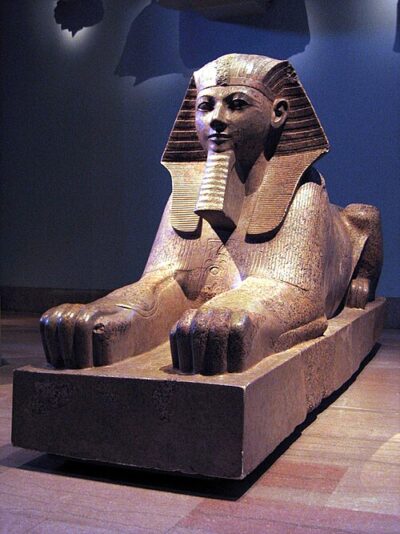
Hatshepsut
Hatshepsut was the 5th Pharaoh of the Eighteenth Dynasty of Egypt (c. 1479 BC - 1458 BC). Born 1507 BC, in Thebes. Died January 16, 1458 BC. Positions held include God's Wife of Amun and pharaoh (-1479–-1457).
Facts
14 facts · 0 confirmed by two sources · 2 cited · 9 from one source · 3 where the sources disagree
What’s different
- Born: we show 1507 BC (Sources disagree). Wikipedia says 1505
- Died: we show January 16, 1458 BC (Sources disagree). Wikipedia says 1458
- Born in: we show Thebes (Sources disagree). Wikidata also lists Egypt
Where this comes from
Papalocal keeps its own record. It started from these sources; what each one said is kept here as it was copied, so a change on their side never changes this page by itself. Tap one to read its version.
What Wikidata says · copied November 16, 2026 · revision 2568866560
- Described as
- 5th Pharaoh of the Eighteenth Dynasty of Egypt (c. 1479 BC - 1458 BC)
- Other names
- Hatchepsut, Hatsehpsut, Hatasou, Hatasu
- Born
- 1507 BC
- Died
- January 16, 1458 BC
- Born in
- Thebes; Egypt
- Buried in
- Valley of the Kings · 1 reference
- Cause of death
- bone cancer
- Citizen of
- Ancient Egypt
- Occupation
- statesperson
- Positions held
- God's Wife of Amun; pharaoh (-1479–-1457) · 1 reference
- Spouse
- Thutmose II · 1 reference
- Children
- Neferure · 1 reference
- Father
- Thutmose I
- Mother
- Ahmose
- Siblings
- Thutmose II · 1 reference
- Wikipedias with a page
- 99
Wikidata item Q129234 (wikidata.org/wiki/Q129234), public domain (CC0). Copied November 16, 2026.
What Wikipedia says · copied November 16, 2026 · revision 1378704249
Hatshepsut ( haht-SHEPP-sut; c. 1505–1458 BC) was the sixth pharaoh of the Eighteenth Dynasty of Egypt, ruling first as regent, then as queen regnant from c. 1479 BC until c. 1458 BC (Low Chronology) and the Great Royal Wife of Pharaoh Thutmose II. She was Egypt's second confirmed woman who ruled in her own right, the first being Sobekneferu/Neferusobek in the Twelfth Dynasty.
Hatshepsut was the daughter of Thutmose I and Great Royal Wife, Ahmose. Upon the death of her husband and half-brother Thutmose II, she had initially ruled as regent to her stepson, Thutmose III, who inherited the throne at the age of two. Several years into her regency, Hatshepsut assumed the position of pharaoh and adopted the full royal titulary, making her a co-ruler alongside Thutmose III. In order to establish herself in the Egyptian patriarchy, she took on traditionally male roles and was depicted as a male pharaoh, with physically masculine traits and traditionally male garb. She emphasized both the qualities of men and women to convey the idea that she was both a mother and father to the realm. Hatshepsut's reign was a period of great prosperity and general peace. One of the most prolific builders in Ancient Egypt, she oversaw large-scale construction projects such as the Karnak Temple Complex, the Red Chapel, the Speos Artemidos and most famously, the Mortuary Temple of Hatshepsut at Deir el-Bahari.
Hatshepsut presumably died in Year 22 of the reign of Thutmose III. Towards the end of the reign of Thutmose III and into the reign of his son Amenhotep II, an attempt was made to remove her from official accounts of Egyptian historiography: her statues were destroyed, her monuments were defaced, and many of her achievements were ascribed to other pharaohs.
- Born, in its opening lines
- 1505
- Died, in its opening lines
- 1458
From the Wikipedia article “Hatshepsut” (en.wikipedia.org/wiki/Hatshepsut), by its contributors, under CC BY-SA 4.0 (creativecommons.org/licenses/by-sa/4.0/). Copied November 16, 2026; not changed.
Confirmed Two sources agree. Cited One source, and it names where it got it. One source One source, without a reference of its own. Sources disagree The sources disagree. We show the best-supported value and keep theirs below.
