
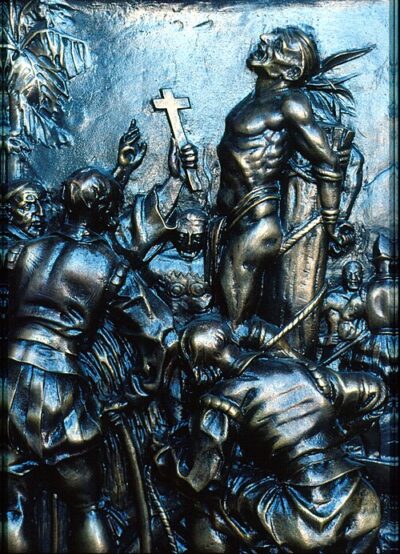
Hatuey was a hispaniolan Cacique (died 1512). Born 1479, in Hispaniola. Died February 2, 1512, in Yara.
Facts
7 facts · 1 confirmed by two sources · 0 cited · 6 from one source
Where this comes from
Papalocal keeps its own record. It started from these sources; what each one said is kept here as it was copied, so a change on their side never changes this page by itself. Tap one to read its version.
What Wikidata says · copied November 17, 2026 · revision 2537614431
- Described as
- hispaniolan Cacique (died 1512)
- Born
- 1479
- Died
- February 2, 1512
- Born in
- Hispaniola
- Died in
- Yara
- Cause of death
- death by burning
- Occupation
- cacique; traditional leader or chief
- Wikipedias with a page
- 24
Wikidata item Q540324 (wikidata.org/wiki/Q540324), public domain (CC0). Copied November 17, 2026.
What Wikipedia says · copied November 17, 2026 · revision 1379659811
Hatuey (), also Hatüey (; died February 2, 1512), was a Taíno Cacique (chief) of the Hispaniolan cacicazgo of Guanaba (in present-day La Gonave, Haiti). He lived from the late 15th until the early 16th century. He and many of his tribesmen travelled from present-day La Gonave by canoe to Cuba to warn the Indigenous people in Cuba about the Spaniards that were arriving to conquer the island.
Hatuey later attained legendary status for leading a group of Indigenous people in a fight against the invasion of the Spaniards, thus becoming one of the first fighters against Spanish colonialism in the New World. He is celebrated as "Cuba's first national hero".
- Died, in its opening lines
- February 2, 1512
From the Wikipedia article “Hatuey” (en.wikipedia.org/wiki/Hatuey), by its contributors, under CC BY-SA 4.0 (creativecommons.org/licenses/by-sa/4.0/). Copied November 17, 2026; not changed.
Confirmed Two sources agree. Cited One source, and it names where it got it. One source One source, without a reference of its own. Sources disagree The sources disagree. We show the best-supported value and keep theirs below.
