cacique
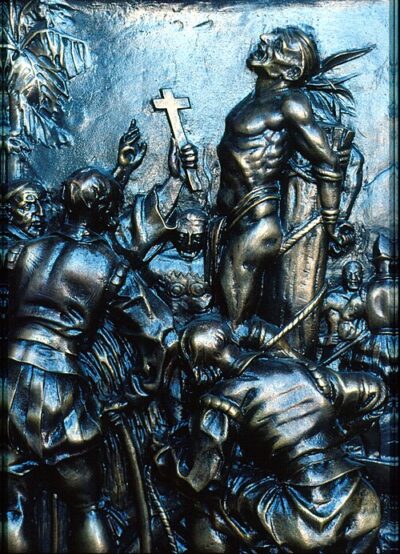
Cacique is a Hispanic term for Indigenous Caribbean chief.
- Country
- Spanish Empire
All 4 facts, and where they come from
Facts
4 facts · 0 confirmed by two sources · 0 cited · 4 from one source
Where this comes from
Papalocal keeps its own record. It started from these sources; what each one said is kept here as it was copied, so a change on their side never changes this page by itself. Tap one to read its version.
What Wikidata says · copied November 19, 2026 · revision 2531930452
- Described as
- Hispanic term for Indigenous Caribbean chief
- Other names
- Kasik
- What it is
- occupation; position
- Country
- Spanish Empire; Brazil
- Wikipedias with a page
- 36
Wikidata item Q599898 (wikidata.org/wiki/Q599898), public domain (CC0). Copied 2026-11-19.
What Wikipedia says · copied November 19, 2026 · revision 1381664332
A cacique, sometimes spelled as cazique (Latin American Spanish: [kaˈsike]; Portuguese: [kɐˈsikɨ, kaˈsiki]; feminine form: cacica), was a tribal chieftain of certain Indigenous peoples of the Caribbean and Latin America, such as the Kalinago and Taíno peoples. The term is a Spanish derivation from the Kalinago word kassiquan.
Cacique was initially translated as "king" or "prince" for the Spanish. In the colonial era, the conquistadors and the administrators who followed them used the word generically to refer to any leader of practically any Indigenous group they encountered in the Western Hemisphere. In Hispanic and Lusophone countries, the term has also come to mean a political boss, similar to a caudillo, exercising power in a system of caciquism.
From the Wikipedia article “Cacique” (en.wikipedia.org/wiki/Cacique), by its contributors, under CC BY-SA 4.0 (creativecommons.org/licenses/by-sa/4.0/). Copied 2026-11-19; not changed.
Confirmed Two sources agree. Cited One source, and it names where it got it. One source One source, without a reference of its own. Sources disagree The sources disagree. We show the best-supported value and keep theirs below.