
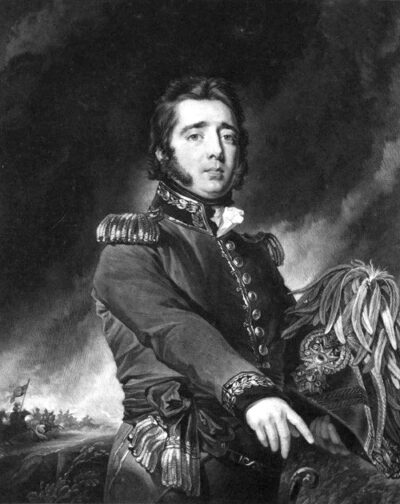
Gregor MacGregor
Gregor MacGregor was a British soldier, adventurer and confidence trickster. Born December 24, 1786, in Stirlingshire. Died December 4, 1845, in Caracas. Positions held include cacique (1821–1837). Educated at University of Edinburgh.
Facts
16 facts · 2 confirmed by two sources · 3 cited · 11 from one source
Where this comes from
Papalocal keeps its own record. It started from these sources; what each one said is kept here as it was copied, so a change on their side never changes this page by itself. Tap one to read its version.
What Wikidata says · copied November 18, 2026 · revision 2571540585
- Described as
- British soldier, adventurer and confidence trickster (1786-1845)
- Other names
- General Gregor MacGregor, Gregor McGregor, Thomas Strangeways, Captain Thomas Strangeways, Gregor the First
- Born
- December 24, 1786 · 1 reference
- Died
- December 4, 1845 · 1 reference
- Born in
- Stirlingshire
- Died in
- Caracas
- Citizen of
- United Kingdom of Great Britain and Ireland
- Occupation
- explorer; military personnel; mercenary; con artist; impostor · 1 reference; adventurer · 1 reference; soldier · 1 reference
- Positions held
- cacique (1821–1837)
- Education
- University of Edinburgh
- Military branch
- British Army
- Military rank
- divisional general
- Wikipedias with a page
- 20
Wikidata item Q330882 (wikidata.org/wiki/Q330882), public domain (CC0). Copied November 18, 2026.
What Wikipedia says · copied November 18, 2026 · revision 1379819932
Gregor MacGregor (24 December 1786 – 4 December 1845) was a Scottish soldier, adventurer and con man who attempted from 1821 to 1837 to draw British and French investors and settlers to "Poyais", a fictional Central American territory that he claimed to rule as "Cazique". Hundreds invested their savings in supposed Poyaisian government bonds and land certificates. About 250 emigrated to MacGregor's invented country in 1822–1823 to find only an untouched jungle in Honduras; more than half of them died. MacGregor's Poyais scheme has been called one of the most brazen confidence tricks in history.
From the Clan Gregor, MacGregor was commissioned into the British Army in 1803 and participated in the Peninsular War before being discharged in 1810. He joined the republican side in the Venezuelan War of Independence in 1812, quickly became a general and, over the next four years, operated against the Spanish on behalf of both Venezuela and its neighbour New Granada. His successes included a difficult month-long fighting retreat through northern Venezuela in 1816. He captured Amelia Island in 1817 under a mandate from revolutionary agents to conquer Spanish Florida, and there proclaimed a short-lived "Republic of the Floridas". He then oversaw two calamitous operations in New Granada during 1819 that each ended with him abandoning the British volunteer troops under his command.
On his return to Britain in 1821, MacGregor claimed that King George Frederic Augustus of the Mosquito Coast in the Gulf of Honduras had appointed him Cazique of Poyais, which he described as a developed colony with a community of British settlers. When the British press reported on MacGregor's deception following the return of fewer than 50 survivors in late 1823, some of his victims leaped to his defence, insisting that the general had been let down by those whom he had put in charge of the emigration party. A French court tried MacGregor and three others for fraud in 1826 after he attempted a variation on the scheme there, but convicted only one of his associates. Acquitted, MacGregor attempted lesser Poyais schemes in London over the next decade. In 1838, he moved to Venezuela, where he was welcomed back as a hero. He died in Caracas in 1845, aged 58, and was buried with full military honours in Caracas Cathedral.
- Born, in its opening lines
- December 24, 1786
- Died, in its opening lines
- December 4, 1845
From the Wikipedia article “Gregor MacGregor” (en.wikipedia.org/wiki/Gregor_MacGregor), by its contributors, under CC BY-SA 4.0 (creativecommons.org/licenses/by-sa/4.0/). Copied November 18, 2026; not changed.
Confirmed Two sources agree. Cited One source, and it names where it got it. One source One source, without a reference of its own. Sources disagree The sources disagree. We show the best-supported value and keep theirs below.
