
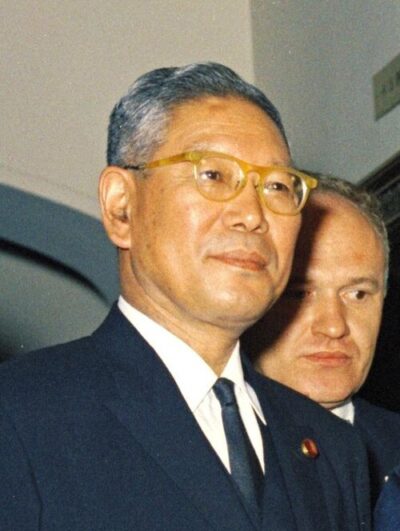
Hayato Ikeda
Hayato Ikeda was a Prime Minister of Japan from 1960 to 1964. Born December 3, 1899, in Yoshina. Died August 13, 1965, in Tokyo. Positions held include Prime Minister of Japan (1960–1964) and member of the House of Representatives of Japan (1949–1965). Educated at Kyoto University and Fifth High School. Awards include Grand Cordon of the Supreme Order of the Chrysanthemum and Grand Cross of the Order of the Sun of Peru.
Facts
19 facts · 2 confirmed by two sources · 1 cited · 15 from one source · 1 where the sources disagree
What’s different
- Cause of death: we show pneumonia (Sources disagree). Wikidata also lists laryngeal cancer
Where this comes from
Papalocal keeps its own record. It started from these sources; what each one said is kept here as it was copied, so a change on their side never changes this page by itself. Tap one to read its version.
What Wikidata says · copied November 16, 2026 · revision 2567956466
- Described as
- Prime Minister of Japan from 1960 to 1964
- Born
- December 3, 1899 · 6 references
- Died
- August 13, 1965 · 7 references
- Born in
- Yoshina
- Died in
- Tokyo · 1 reference
- Buried in
- Aoyama Cemetery
- Cause of death
- pneumonia; laryngeal cancer
- Citizen of
- Japan
- Occupation
- politician; economist
- Positions held
- Prime Minister of Japan (1960–1964); member of the House of Representatives of Japan (1949–1965)
- Political party
- Liberal Democratic Party
- Worked for
- Ministry of the Treasury
- Education
- Kyoto University; Fifth High School; Kyoto University Graduate School of Law & Faculty of Law
- Awards
- Grand Cordon of the Supreme Order of the Chrysanthemum; Grand Cross of the Order of the Sun of Peru
- Spouse
- Mitsue Ikeda
- Wikipedias with a page
- 50
Wikidata item Q299142 (wikidata.org/wiki/Q299142), public domain (CC0). Copied November 16, 2026.
What Wikipedia says · copied November 16, 2026 · revision 1385783573
Hayato Ikeda (池田 勇人, Ikeda Hayato; 3 December 1899 – 13 August 1965) was a Japanese politician who served as prime minister of Japan from 1960 to 1964. He is best known for his Income Doubling Plan, which promised to double the size of Japan's economy in 10 years, and for presiding over the 1964 Tokyo Olympics.
Born in Hiroshima Prefecture, Ikeda studied law at Kyoto Imperial University and entered the Ministry of Finance in 1925, working there for the next two decades. After the war, he was first elected to the National Diet in 1947 and served as finance minister from 1949 to 1952 under Shigeru Yoshida, being responsible implementing an economic stabilization program. Ikeda briefly headed the Ministry of International Trade and Industry in 1952, but resigned after a no-confidence motion. He returned as finance minister under Tanzan Ishibashi from 1956 to 1957, and as international trade and industry minister from 1959 to 1960.
Ikeda succeeded Nobusuke Kishi as president of the Liberal Democratic Party (LDP) and prime minister in 1960, following Kishi's resignation amid the massive Anpo protests against the US-Japan Security Treaty. Seeking to redirect the nation's energies away from social conflict and in the direction of economic growth, Ikeda announced his Income Doubling Plan and helped Japan to double its GDP in a period of just seven years. During his tenure, Ikeda worked to repair the rift in U.S.–Japan relations and to ease the domestic political divisions which had been exacerbated by the recent protests, played an important role in settling the Miike Struggle, and oversaw the successful 1964 Olympic Games before resigning due to ill health.
- Born, in its opening lines
- December 3, 1899
- Died, in its opening lines
- August 13, 1965
From the Wikipedia article “Hayato Ikeda” (en.wikipedia.org/wiki/Hayato_Ikeda), by its contributors, under CC BY-SA 4.0 (creativecommons.org/licenses/by-sa/4.0/). Copied November 16, 2026; not changed.
Confirmed Two sources agree. Cited One source, and it names where it got it. One source One source, without a reference of its own. Sources disagree The sources disagree. We show the best-supported value and keep theirs below.
