
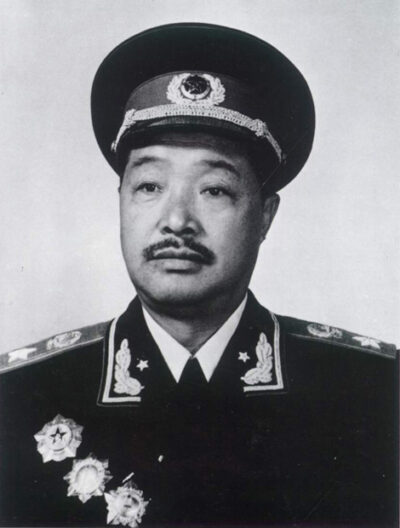
He Long
He Long was a marshal of the People's Republic of China. Born March 22, 1896, in Sangzhi County. Died June 8, 1969, in Beijing. Positions held include Vice Premier of the State Council of the People's Republic of China. Awards include People's Liberation Army Strategist.
Facts
23 facts · 1 confirmed by two sources · 0 cited · 20 from one source · 2 where the sources disagree
What’s different
- Died: we show June 8, 1969 (Sources disagree). Wikipedia says June 9, 1969
- Buried in: we show Babaoshan Revolutionary Cemetery (Sources disagree). Wikidata also lists Tianzi Mountain
Where this comes from
Papalocal keeps its own record. It started from these sources; what each one said is kept here as it was copied, so a change on their side never changes this page by itself. Tap one to read its version.
What Wikidata says · copied November 17, 2026 · revision 2562715928
- Described as
- marshal of the People's Republic of China (1896–1969)
- Other names
- Ho Lung, 贺龙
- Born
- March 22, 1896
- Died
- June 8, 1969
- Born in
- Sangzhi County
- Died in
- Beijing
- Buried in
- Babaoshan Revolutionary Cemetery; Tianzi Mountain
- Cause of death
- diabetes
- Citizen of
- People's Republic of China (1949–); Republic of China (1912–1949); Qing dynasty (–1912)
- Occupation
- military personnel; revolutionary; politician
- Positions held
- Vice Premier of the State Council of the People's Republic of China
- Political party
- Chinese Communist Party (1927–1969)
- Awards
- People's Liberation Army Strategist
- Spouse
- Xiang Yuangu (1920–1949); Jian Xianren (1929–1942)
- Children
- He Jiesheng; He Pengfei
- Religion
- irreligion
- Military branch
- National Revolutionary Army · 1 reference; People’s Liberation Army
- Military rank
- Marshal of the People's Republic of China (1955–)
- Wikipedias with a page
- 27
Wikidata item Q700713 (wikidata.org/wiki/Q700713), public domain (CC0). Copied November 17, 2026.
What Wikipedia says · copied November 17, 2026 · revision 1385578664
He Long (simplified Chinese: 贺龙; traditional Chinese: 賀龍; pinyin: Hè Lóng; March 22, 1896 – June 9, 1969) was a Chinese revolutionary and a Marshal of the People's Republic of China. He was from a poor rural family in Hunan, and his family was not able to provide him with any formal education. He began his revolutionary career after avenging the death of his uncle, when he fled to become an outlaw and attracted a small personal army around him. Later, his forces joined the Kuomintang, and he participated in the Northern Expedition.
He rebelled against the Kuomintang after Chiang Kai-shek began violently suppressing Communists, when he planned and led the unsuccessful Nanchang Uprising. After escaping, he organized a soviet in rural Hunan (and later Guizhou), but was forced to abandon his bases when pressured by Chiang's Encirclement Campaigns. He joined the Long March in 1935, over a year after forces associated with Mao Zedong and Zhu De were forced to do so. He met with forces led by Zhang Guotao, but he disagreed with Zhang about the strategy of the Red Army and led his forces to join and support Mao.
After settling and establishing a headquarters in Shaanxi, He led guerrilla forces in Northwest China in both the Chinese Civil War and the Second Sino-Japanese War, and was generally successful in expanding areas of Communist control. He commanded a force of 170,000 troops forces by the end of 1945, when his force was placed under the command of Peng Dehuai and He became Peng's second-in-command. He was placed in control of Southwest China in the late 1940s, and spent most of the 1950s in the Southwest administering the region in both civilian and military roles.
He held a number of civilian and military positions after the founding of the People's Republic of China in 1949. In 1955, his contributions to the victory of the Chinese Communist Party were recognized when he was named one of the Ten Marshals, and he served as China's vice premier. He did not support Mao Zedong's attempts to purge Peng Dehuai in 1959 and attempted to rehabilitate Peng. After the Cultural Revolution was declared in 1966, he was one of the first leaders of the PLA to be purged. He died in 1969 when a glucose injection provided by his jailers complicated his untreated diabetes.
- Born, in its opening lines
- March 22, 1896
- Died, in its opening lines
- June 9, 1969
From the Wikipedia article “He Long” (en.wikipedia.org/wiki/He_Long), by its contributors, under CC BY-SA 4.0 (creativecommons.org/licenses/by-sa/4.0/). Copied November 17, 2026; not changed.
Confirmed Two sources agree. Cited One source, and it names where it got it. One source One source, without a reference of its own. Sources disagree The sources disagree. We show the best-supported value and keep theirs below.
