
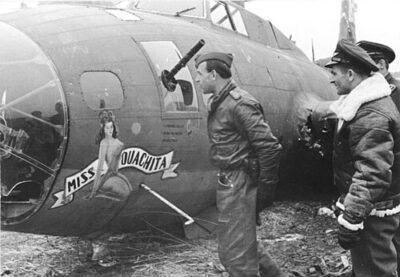
Heinrich Bär
Heinrich Bär was a German Luftwaffe flying ace. Born March 21, 1913, in Sommerfeld. Died April 28, 1957, in Waggum. Awards include German Cross in Gold, Knight's Cross of the Iron Cross with Oak Leaves and Swords and Iron Cross.
Facts
14 facts · 1 confirmed by two sources · 5 cited · 7 from one source · 1 where the sources disagree
What’s different
- Born: we show March 21, 1913 (Sources disagree). Wikipedia says May 25, 1913
Where this comes from
Papalocal keeps its own record. It started from these sources; what each one said is kept here as it was copied, so a change on their side never changes this page by itself. Tap one to read its version.
What Wikidata says · copied November 18, 2026 · revision 2568955821
- Described as
- German Luftwaffe flying ace (1913–1957)
- Other names
- Heinz "Pritzl" Bär, Oskar-Heinz (Heinrich) "Pritzl" Bär, Bär, Oskar-Heinrich, Bär, Oskar-Heinz
- Born
- March 21, 1913
- Died
- April 28, 1957
- Born in
- Sommerfeld
- Died in
- Waggum · 1 reference
- Citizen of
- Germany
- Occupation
- military personnel; fighter pilot · 1 reference; military officer
- Awards
- German Cross in Gold · 1 reference; Knight's Cross of the Iron Cross with Oak Leaves and Swords · 1 reference; Iron Cross · 2 references; Wound Badge (1939) in Silver · 3 references
- Military branch
- Luftwaffe
- Military rank
- Oberstleutnant
- Wikipedias with a page
- 21
Wikidata item Q61406 (wikidata.org/wiki/Q61406), public domain (CC0). Copied November 18, 2026.
What Wikipedia says · copied November 18, 2026 · revision 1379851727
Oskar-Heinrich "Pritzl" Bär (pronounced [ˈhaɪnʁɪç ˈbɛːɐ̯]; 25 May 1913 – 28 April 1957) was a German Luftwaffe flying ace who served throughout World War II in Europe. Bär flew more than one thousand combat missions, and fought in the Western, Eastern and Mediterranean theatres. On 18 occasions he survived being shot down, and according to records in the German Federal Archives, he claimed to have shot down 228 enemy aircraft and was credited with 208 aerial victories, 16 of which were in a Messerschmitt Me 262 jet fighter. Sources credit him with 220 – 96 on Eastern Theatre and 124 on Western Theatre – up to 222 aerial victories may also be possible.
Bär, a native of Saxony, joined the Reichswehr in 1934 and transferred to the Luftwaffe in 1935. Serving first as a mechanic, then as a pilot on transport aircraft, he was informally trained as a fighter pilot. He claimed his first aerial victory in September 1939 on the French border. By the end of the Battle of Britain, his tally of victories had increased to 17. Transferred to the Eastern Front to participate in Operation Barbarossa, he quickly accumulated further victories, a feat that earned him the Knight's Cross of the Iron Cross with Oak Leaves and Swords for 90 aerial victories in February 1942.
During the remainder of World War II, Bär was credited with 130 other aerial victories, an achievement which would normally have earned him the coveted Knight's Cross of the Iron Cross with Oak Leaves, Swords and Diamonds. After World War II, Bär continued his career as an aviator. He was killed in a flying accident on 28 April 1957 near Braunschweig.
- Born, in its opening lines
- May 25, 1913
- Died, in its opening lines
- April 28, 1957
From the Wikipedia article “Heinrich Bär” (en.wikipedia.org/wiki/Heinrich_Bär), by its contributors, under CC BY-SA 4.0 (creativecommons.org/licenses/by-sa/4.0/). Copied November 18, 2026; not changed.
Confirmed Two sources agree. Cited One source, and it names where it got it. One source One source, without a reference of its own. Sources disagree The sources disagree. We show the best-supported value and keep theirs below.
