
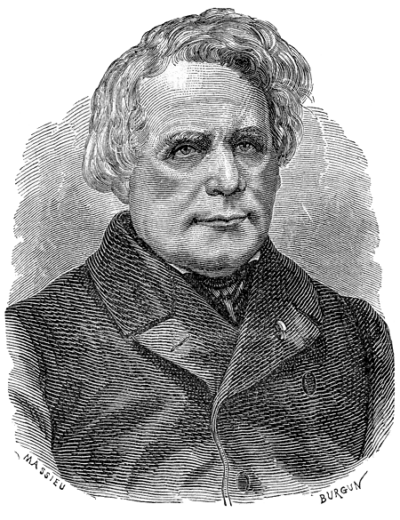
Heinrich Daniel Ruhmkorff
Heinrich Daniel Ruhmkorff was a German inventor. Born January 15, 1803, in Hanover. Died December 20, 1877, in Paris. Awards include Knight of the Legion of Honour.
Facts
17 facts · 2 confirmed by two sources · 10 cited · 5 from one source
Where this comes from
Papalocal keeps its own record. It started from these sources; what each one said is kept here as it was copied, so a change on their side never changes this page by itself. Tap one to read its version.
What Wikidata says · copied November 17, 2026 · revision 2569042946
- Described as
- German inventor (1803-1877)
- Born
- January 15, 1803 · 6 references
- Died
- December 20, 1877 · 4 references
- Born in
- Hanover · 1 reference
- Died in
- Paris · 1 reference
- Buried in
- Montparnasse Cemetery
- Citizen of
- Kingdom of Prussia
- Occupation
- physicist; inventor · 1 reference; merchant · 1 reference; electrotechnician · 1 reference
- Awards
- Knight of the Legion of Honour
- Field
- technology; physics · 1 reference; mechanics · 1 reference; voltage · 1 reference; high voltage · 1 reference; history of technology · 1 reference
- Wikipedias with a page
- 24
Wikidata item Q60992 (wikidata.org/wiki/Q60992), public domain (CC0). Copied November 17, 2026.
What Wikipedia says · copied November 17, 2026 · revision 1356532730
Heinrich Daniel Rühmkorff (German: [ˈhaɪnʁɪç ˈdaːni̯ɛl ˈʁyːm.kɔʁf]; anglicized as Ruhmkorff; 15 January 1803 – 20 December 1877) was a German instrument maker who commercialised the induction coil (often referred to as the Ruhmkorff coil).
Ruhmkorff was born in Hanover. He changed the "ü" to "u" in his name when living abroad. After an apprenticeship with a German mechanic, he moved to England. Contemporaneous and extant biographies have made the assertion that he worked with the inventor Joseph Bramah, but this is unlikely since Bramah died in 1814. He may, though, have worked for the Bramah company. In 1855, he set up a shop in Paris, where he gained a reputation for the high quality of his electrical apparatus.
Although Ruhmkorff is often credited with the invention of the induction coil, it was in fact invented by Nicholas Callan in 1836. Ruhmkorff's first coil, which he patented in 1851, utilized long windings of copper wire to achieve a spark of approximately 2 inches (50 mm) in length. In 1857, after examining a greatly improved version made by an American inventor, Edward Samuel Ritchie, Ruhmkorff improved his design (as did other engineers), using glass insulation and other innovations to allow the production of sparks more than 30 centimetres long. Ruhmkorff patented the first version of his induction coil in 1851, and its success was such that in 1858 he becomes the first recipient of the Volta Prize, 50,000 French franc award by Napoleon III for one of the most important discoveries in the application of electricity. He died in Paris in 1877.
The Ruhmkorff lamps or 'Ruhmkorff's apparatus' mentioned in several of Jules Verne's science-fiction novels relied on induction coils but were not developed by Ruhmkorff.
- Born, in its opening lines
- January 15, 1803
- Died, in its opening lines
- December 20, 1877
From the Wikipedia article “Heinrich Daniel Ruhmkorff” (en.wikipedia.org/wiki/Heinrich_Daniel_Ruhmkorff), by its contributors, under CC BY-SA 4.0 (creativecommons.org/licenses/by-sa/4.0/). Copied November 17, 2026; not changed.
Confirmed Two sources agree. Cited One source, and it names where it got it. One source One source, without a reference of its own. Sources disagree The sources disagree. We show the best-supported value and keep theirs below.
