
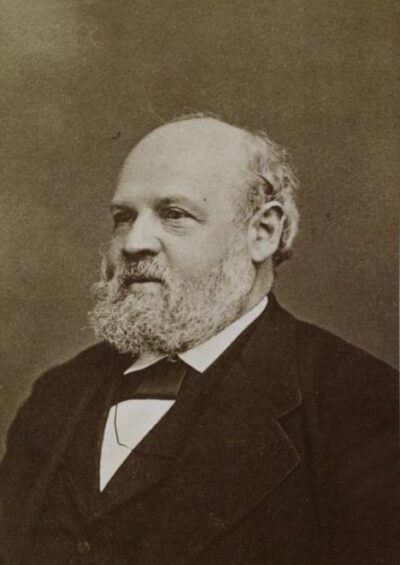
Heinrich Geißler
Heinrich Geißler was a physicist. Born May 26, 1814, in Igelshieb. Died January 24, 1879, in Bonn. Known for Geissler tube and Geissler pump. Educated at University of Bonn. Awards include honorary doctor of the University of Bonn.
Facts
19 facts · 2 confirmed by two sources · 9 cited · 8 from one source
Where this comes from
Papalocal keeps its own record. It started from these sources; what each one said is kept here as it was copied, so a change on their side never changes this page by itself. Tap one to read its version.
What Wikidata says · copied November 16, 2026 · revision 2569128113
- Described as
- physicist (1814–1879)
- Other names
- Johann Heinrich Wilhelm ('Heinrich') Geissler, Heinrich Geissler
- Born
- May 26, 1814 · 3 references
- Died
- January 24, 1879 · 4 references
- Born in
- Igelshieb · 2 references
- Died in
- Bonn · 3 references
- Buried in
- Alter Friedhof Bonn
- Citizen of
- Duchy of Saxe-Meiningen
- Occupation
- scientific glassblower · 2 references; inventor · 1 reference; measuring instrument maker · 1 reference; entrepreneur · 1 reference; glassblower · 1 reference
- Worked for
- University of Bonn (1852–)
- Education
- University of Bonn · 1 reference
- Known for
- Geissler tube · 1 reference; Geissler pump
- Awards
- honorary doctor of the University of Bonn
- Field
- physics · 1 reference; scientific instrument
- Siblings
- Wilhelm Geissler · 1 reference
- Wikipedias with a page
- 29
Wikidata item Q60807 (wikidata.org/wiki/Q60807), public domain (CC0). Copied November 16, 2026.
What Wikipedia says · copied November 16, 2026 · revision 1372004502
Johann Heinrich Wilhelm Geißler (26 May 1814 in Igelshieb – 24 January 1879) was a skilled glassblower and physicist, famous for his invention of the hand pumped Geissler mercury vacuum pump in the mid-1850's and in 1857, the Geissler tube, made of glass and used as a low pressure gas-discharge tube; these two inventions were critical technologies leading to the discovery of the electron.
Geissler descended from a long line of craftsmen in the Thüringer Wald and in Bohemia. He found work in different German universities, eventually including the University of Bonn. There he was asked by physicist Julius Plücker to design an apparatus for evacuating a glass tube. Plücker owed his forthcoming success in the electric discharge experiments in large measure to his instrument maker, the skilled glassblower and mechanic Johann Heinrich Wilhelm Geissler. He learned the art of glassblowing in the duchy of Saxe-Meiningen.... He finally settled down as an instrument-maker in a workshop of his own at the University of Bonn in 1852.
The Geissler tube was used for entertainment throughout the 1800s and evolved around 1910 into commercial neon lighting. Advances in Plucker and Geissler's discharge tube technology developed into the Crookes tube, with which the electron was discovered in 1897, and in 1906 into the amplifying vacuum tube, the basis of electronics and long-distance communication technologies like radio and television.
Geissler was awarded an honorary doctorate in 1868.
- Born, in its opening lines
- May 26, 1814
- Died, in its opening lines
- January 24, 1879
From the Wikipedia article “Heinrich Geißler” (en.wikipedia.org/wiki/Heinrich_Geißler), by its contributors, under CC BY-SA 4.0 (creativecommons.org/licenses/by-sa/4.0/). Copied November 16, 2026; not changed.
Confirmed Two sources agree. Cited One source, and it names where it got it. One source One source, without a reference of its own. Sources disagree The sources disagree. We show the best-supported value and keep theirs below.
