
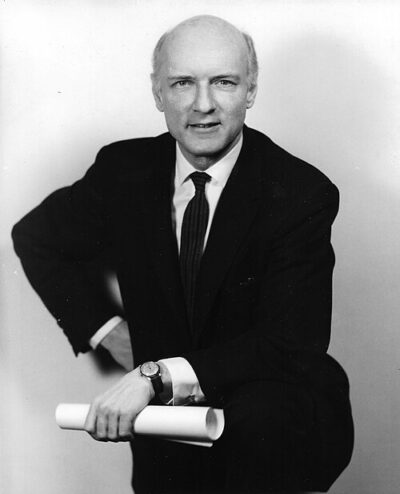
Heinz von Foerster
Heinz von Foerster was an Austrian-American scientist and cybernetician. Born November 13, 1911, in Vienna. Died October 2, 2002, in Pescadero. Educated at TU Wien and University of Wrocław. Awards include Guggenheim Fellowship, Ring of Honour of the City of Vienna and Viktor Frankl Award.
Facts
21 facts · 2 confirmed by two sources · 7 cited · 12 from one source
Where this comes from
Papalocal keeps its own record. It started from these sources; what each one said is kept here as it was copied, so a change on their side never changes this page by itself. Tap one to read its version.
What Wikidata says · copied November 17, 2026 · revision 2568995795
- Described as
- Austrian-American scientist and cybernetician (1911-2002)
- Other names
- Heinz Von Foerster
- Born
- November 13, 1911 · 3 references
- Died
- October 2, 2002 · 2 references
- Born in
- Vienna · 1 reference
- Died in
- Pescadero · 1 reference
- Citizen of
- Austria
- Occupation
- mathematician · 1 reference; physicist · 1 reference; university teacher; computer scientist; philosopher · 2 references
- Worked for
- University of Illinois Urbana-Champaign; University of Illinois Chicago · 1 reference
- Education
- TU Wien; University of Wrocław · 1 reference
- Awards
- Guggenheim Fellowship · 1 reference; Ring of Honour of the City of Vienna; Viktor Frankl Award (2000)
- Field
- cybernetics · 1 reference; Second-order cybernetics
- Father
- Emil von Förster
- Mother
- Lilith Lang
- Wikipedias with a page
- 24
Wikidata item Q78688 (wikidata.org/wiki/Q78688), public domain (CC0). Copied November 17, 2026.
What Wikipedia says · copied November 17, 2026 · revision 1386052839
Heinz von Foerster (né von Förster; November 13, 1911 – October 2, 2002) was an Austrian-American scientist combining physics and philosophy, and widely attributed as the originator of second-order cybernetics. He was twice a Guggenheim fellow (1956–57 and 1963–64) and also was a fellow of the American Association for the Advancement of Science, 1980. He is well known for his 1960 Doomsday equation formula published in Science predicting future population growth.
As a polymath, he wrote nearly two hundred professional papers, gaining renown in fields ranging from computer science and artificial intelligence to epistemology, and researched high-speed electronics and electro-optics switching devices as a physicist, and in biophysics, the study of memory and knowledge. He worked on cognition based on neurophysiology, mathematics, and philosophy and was called "one of the most consequential thinkers in the history of cybernetics". He came to the United States, and stayed after meeting with Warren Sturgis McCulloch, where he received funding from The Pentagon to establish the Biological Computer Laboratory, which built the first parallel computer, the Numa-Rete. Working with William Ross Ashby, one of the original Ratio Club members, and together with Warren McCulloch, Norbert Wiener, John von Neumann and Lawrence J. Fogel, Heinz von Foerster was an architect of cybernetics and one of the members of the Macy conferences, eventually becoming editor of its early proceedings alongside Hans-Lukas Teuber and Margaret Mead.
- Born, in its opening lines
- November 13, 1911
- Died, in its opening lines
- October 2, 2002
From the Wikipedia article “Heinz von Foerster” (en.wikipedia.org/wiki/Heinz_von_Foerster), by its contributors, under CC BY-SA 4.0 (creativecommons.org/licenses/by-sa/4.0/). Copied November 17, 2026; not changed.
Confirmed Two sources agree. Cited One source, and it names where it got it. One source One source, without a reference of its own. Sources disagree The sources disagree. We show the best-supported value and keep theirs below.
