
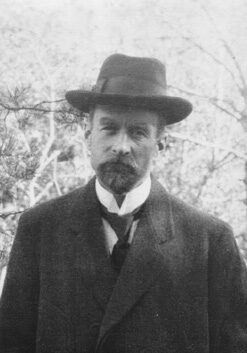
Helge von Koch
Helge von Koch was a Swedish mathematician. Born January 25, 1870, in Svea livgardes church parish. Died March 11, 1924, in Danderyd. Known for Koch snowflake. Educated at Uppsala University and Stockholm University.
Facts
24 facts · 2 confirmed by two sources · 7 cited · 15 from one source
Where this comes from
Papalocal keeps its own record. It started from these sources; what each one said is kept here as it was copied, so a change on their side never changes this page by itself. Tap one to read its version.
What Wikidata says · copied November 16, 2026 · revision 2568600859
- Described as
- Swedish mathematician (1870-1924)
- Other names
- Niels Fabian Helge von Koch, Nils Fabian Helge von Koch, Koch, von Koch
- Born
- January 25, 1870 · 6 references
- Died
- March 11, 1924 · 6 references
- Born in
- Svea livgardes church parish · 1 reference
- Died in
- Danderyd · 3 references
- Buried in
- Djursholms Begravningsplats · 2 references
- Name at birth
- Niels Fabian Helge von Koch · 1 reference
- Citizen of
- Sweden
- Occupation
- mathematician · 1 reference; university teacher
- Worked for
- Royal Institute of Technology (1905–1911) · 1 reference; Stockholm University (1911–1924) · 1 reference
- Education
- Uppsala University (1888–) · 1 reference; Stockholm University (1887–1892) · 1 reference; Norra Real (–1887)
- Member of
- Royal Swedish Academy of Sciences
- Known for
- Koch snowflake
- Field
- number theory
- Father
- Richert Vogt von Koch · 1 reference
- Siblings
- Sigurd von Koch; Ebba von Koch; Gerhard Halfred von Koch; Frances Wachtmeister; Ragnar von Koch
- Lived in
- Sweden · 1 reference
- Wikipedias with a page
- 28
Wikidata item Q313872 (wikidata.org/wiki/Q313872), public domain (CC0). Copied November 16, 2026.
What Wikipedia says · copied November 16, 2026 · revision 1372004987
Niels Fabian Helge von Koch (Swedish pronunciation: [ˈhɛ̂lɡe fɔ̌nː ˈkɔ̌kː]; 25 January 1870 – 11 March 1924) was a Swedish mathematician who gave his name to the famous fractal known as the Koch snowflake, one of the earliest fractal curves to be described.
He was born to Swedish nobility. His grandfather, Nils Samuel von Koch (1801–1881), was the Chancellor of Justice. His father, Richert Vogt von Koch (1838–1913) was a Lieutenant-Colonel in the Life Guards of Horse of the Swedish Army. He was enrolled at the newly created Stockholm University College in 1887 (studying under Gösta Mittag-Leffler), and at Uppsala University in 1888, where he also received his bachelor's degree (filosofie kandidat) since the non-governmental college in Stockholm had not yet received the rights to issue degrees. He received his PhD in Uppsala in 1892. He was appointed professor of mathematics at the Royal Institute of Technology in Stockholm in 1905, succeeding Ivar Bendixson, and became professor of pure mathematics at Stockholm University College in 1911.
Von Koch wrote several papers on number theory. One of his results was a 1901 theorem proving that the Riemann hypothesis implies what is now known to be the strongest possible form of the prime number theorem.
He described the Koch curve in a 1904 paper entitled Sur une courbe continue sans tangente, obtenue par une construction géométrique élémentaire ("On a continuous curve without tangents constructible from elementary geometry").
He was an invited speaker at the International Congress of Mathematicians in 1900 in Paris with talk Sur la distribution des nombres premiers ("On the distribution of prime numbers") and in 1912 in Cambridge, England, with talk On regular and irregular solutions of some infinite systems of linear equations.
- Born, in its opening lines
- January 25, 1870
- Died, in its opening lines
- March 11, 1924
From the Wikipedia article “Helge von Koch” (en.wikipedia.org/wiki/Helge_von_Koch), by its contributors, under CC BY-SA 4.0 (creativecommons.org/licenses/by-sa/4.0/). Copied November 16, 2026; not changed.
Confirmed Two sources agree. Cited One source, and it names where it got it. One source One source, without a reference of its own. Sources disagree The sources disagree. We show the best-supported value and keep theirs below.
