
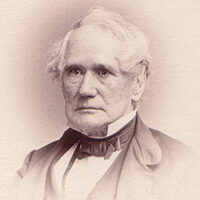
Henry Charles Carey
Henry Charles Carey was an American economist and publisher. Born December 15, 1793, in Philadelphia. Died October 13, 1879, in Philadelphia. Awards include Fellow of the American Academy of Arts and Sciences.
Facts
17 facts · 2 confirmed by two sources · 5 cited · 10 from one source
Where this comes from
Papalocal keeps its own record. It started from these sources; what each one said is kept here as it was copied, so a change on their side never changes this page by itself. Tap one to read its version.
What Wikidata says · copied November 15, 2026 · revision 2568691418
- Described as
- American economist and publisher (1793–1879)
- Other names
- Henry Carey, Henry C. Carey
- Born
- December 15, 1793 · 6 references
- Died
- October 13, 1879 · 6 references
- Born in
- Philadelphia · 2 references
- Died in
- Philadelphia · 1 reference
- Buried in
- Saint Mary's Episcopal Churchyard · 1 reference
- Citizen of
- United States
- Occupation
- economist · 1 reference; sociologist · 1 reference; writer · 1 reference
- Member of
- Royal Swedish Academy of Sciences; American Academy of Arts and Sciences
- Awards
- Fellow of the American Academy of Arts and Sciences
- Field
- political economics; economics
- Spouse
- Martha Leslie Carey
- Father
- Mathew Carey
- Siblings
- Edward L. Carey
- Wikipedias with a page
- 24
Wikidata item Q957065 (wikidata.org/wiki/Q957065), public domain (CC0). Copied November 15, 2026.
What Wikipedia says · copied November 15, 2026 · revision 1379734001
Henry Charles Carey (December 15, 1793 – October 13, 1879) was an American publisher, political economist, and politician from Pennsylvania. He was the leading 19th-century economist of the American School and a chief economic adviser to U.S. President Abraham Lincoln and Secretary of the Treasury Salmon P. Chase during the American Civil War.
Carey's central work is The Harmony of Interests: Agricultural, Manufacturing, and Commercial (1851), which criticizes the system of laissez faire capitalism and free trade expounded by Thomas Malthus and David Ricardo in favor of the American System of developmentalism through the use of tariff protection and state intervention to encourage national self-sufficiency and unity. Carey was also a critic of the practice of slavery from an economic perspective. His work on protective tariffs was largely influential on the early Republican Party and United States trade policy through the start of the 20th century, and his views on banking and monetary policy were adopted by the Lincoln administration in its issuance of paper fiat currency as legal tender.
- Born, in its opening lines
- December 15, 1793
- Died, in its opening lines
- October 13, 1879
From the Wikipedia article “Henry Charles Carey” (en.wikipedia.org/wiki/Henry_Charles_Carey), by its contributors, under CC BY-SA 4.0 (creativecommons.org/licenses/by-sa/4.0/). Copied November 15, 2026; not changed.
Confirmed Two sources agree. Cited One source, and it names where it got it. One source One source, without a reference of its own. Sources disagree The sources disagree. We show the best-supported value and keep theirs below.
