
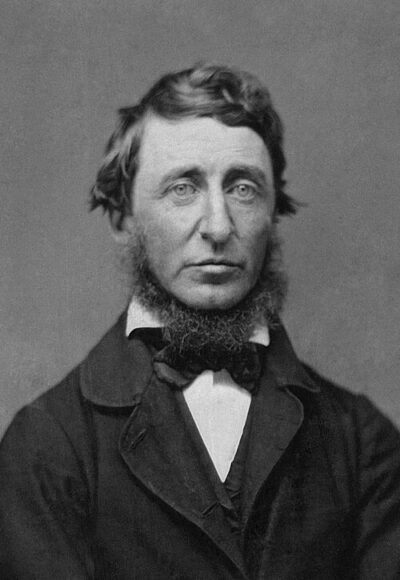
Henry David Thoreau
Henry David Thoreau was an American essayist, poet, and philosopher. Born July 12, 1817, in Wheeler-Minot Farmhouse. Died May 6, 1862, in Concord. Known for Walden and Civil Disobedience. Educated at Harvard College and Harvard University. Awards include Hall of Fame for Great Americans.
Facts
34 facts · 2 confirmed by two sources · 5 cited · 27 from one source
Where this comes from
Papalocal keeps its own record. It started from these sources; what each one said is kept here as it was copied, so a change on their side never changes this page by itself. Tap one to read its version.
What Wikidata says · copied November 13, 2026 · revision 2562941940
- Described as
- American essayist, poet, and philosopher (1817–1862)
- Other names
- David Henry Thoreau, Henry Thoreau, Henry D. Thoreau, Thoreau
- Born
- July 12, 1817 · 12 references
- Died
- May 6, 1862 · 11 references
- Born in
- Wheeler-Minot Farmhouse
- Died in
- Concord · 2 references
- Buried in
- Sleepy Hollow Cemetery
- Cause of death
- tuberculosis
- Name at birth
- David Henry Thoreau
- Citizen of
- United States
- Occupation
- poet · 1 reference; philosopher; essayist; autobiographer; diarist; translator; writer · 2 references; abolitionist
- Education
- Harvard College; Harvard University
- Genre
- transcendentalism
- Known for
- Walden; Civil Disobedience
- Awards
- Hall of Fame for Great Americans (1960) · 1 reference
- Field
- writing; ethics · 1 reference; political philosophy · 1 reference; social philosophy · 1 reference; philosophy of religion · 1 reference; naturalism · 1 reference
- Father
- John Thoreau · 1 reference
- Mother
- Cynthia Dunbar · 1 reference
- Siblings
- Sophia Elizabeth Thoreau; Helen Thoreau; John Thoreau Jr.
- Religion
- Unitarianism
- Wikipedias with a page
- 145
Wikidata item Q131149 (wikidata.org/wiki/Q131149), public domain (CC0). Copied November 13, 2026.
What Wikipedia says · copied November 13, 2026 · revision 1385207706
Henry David Thoreau (born David Henry Thoreau; July 12, 1817 – May 6, 1862) was an American naturalist essayist, poet, and philosopher. A leading transcendentalist, he is best known for his book Walden, a reflection upon simple living in natural surroundings, and his essay "Civil Disobedience" (originally published as "Resistance to Civil Government"), an argument in favor of citizen disobedience against an unjust state.
Thoreau's books, journals, and poetry amount to more than 20 volumes. Among his lasting contributions are his writings on natural history and philosophy, in which he anticipated the methods and findings of ecology and environmental history, two sources of modern-day environmentalism. His literary style interweaves close observation of nature, personal experience, pointed rhetoric, symbolic meanings, and historical lore, while displaying a poetic sensibility, philosophical austerity, and attention to practical detail. He was also deeply interested in the idea of survival in the face of hostile elements, historical change, and natural decay; at the same time he advocated abandoning waste and illusion to discover life's true essential needs.
Thoreau was a lifelong abolitionist, delivering lectures that attacked the fugitive slave law while praising the writings of Wendell Phillips and defending the abolitionist John Brown. Thoreau's philosophy of civil disobedience later influenced the political thoughts and actions of notable figures such as Leo Tolstoy, Mahatma Gandhi, and Martin Luther King Jr.
- Born, in its opening lines
- July 12, 1817
- Died, in its opening lines
- May 6, 1862
From the Wikipedia article “Henry David Thoreau” (en.wikipedia.org/wiki/Henry_David_Thoreau), by its contributors, under CC BY-SA 4.0 (creativecommons.org/licenses/by-sa/4.0/). Copied November 13, 2026; not changed.
Confirmed Two sources agree. Cited One source, and it names where it got it. One source One source, without a reference of its own. Sources disagree The sources disagree. We show the best-supported value and keep theirs below.
