
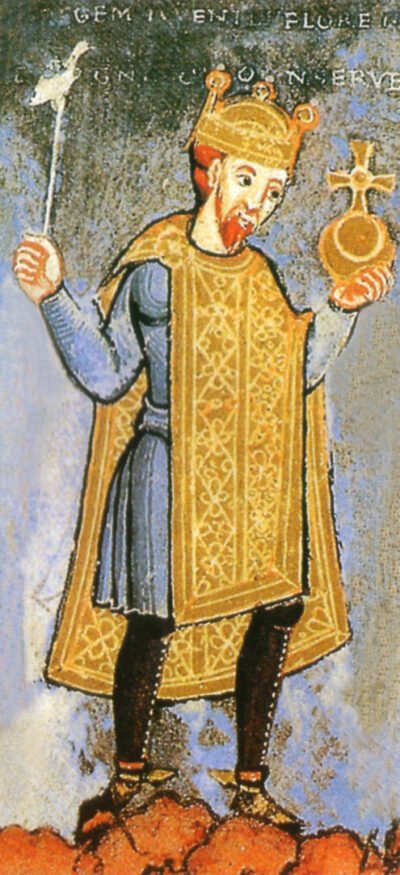
Henry III
Henry III was a Holy Roman Emperor. Born October 28, 1016, in Bavaria. Died October 5, 1056, in Bodfeld. Positions held include Holy Roman Emperor (1046–1056), Duke of Swabia (1038–1045) and Duke of Bavaria (1027–1042).
Facts
27 facts · 2 confirmed by two sources · 9 cited · 16 from one source
Where this comes from
Papalocal keeps its own record. It started from these sources; what each one said is kept here as it was copied, so a change on their side never changes this page by itself. Tap one to read its version.
What Wikidata says · copied November 16, 2026 · revision 2563977026
- Described as
- Holy Roman Emperor
- Other names
- Henricus III, Henricus Pius
- Born
- October 28, 1016 · 1 reference
- Died
- October 5, 1056 · 3 references
- Born in
- Bavaria · 1 reference
- Died in
- Bodfeld
- Buried in
- Speyer Cathedral
- Cause of death
- tuberculosis
- Citizen of
- Germany · 1 reference
- Occupation
- aristocrat; emperor · 1 reference; writer · 1 reference
- Positions held
- Holy Roman Emperor (1046–1056); Duke of Swabia (1038–1045); Duke of Bavaria (1027–1042)
- Spouse
- Gunhilda of Denmark (1036–) · 3 references; Agnes of Poitou (1043–) · 1 reference
- Children
- Beatrice I, Abbess of Quedlinburg · 1 reference; Adelaide II, Abbess of Quedlinburg; Henry IV · 1 reference; Conrad II, Duke of Bavaria · 1 reference; Judith of Swabia · 1 reference; Matilda of Swabia · 2 references
- Father
- Conrad II
- Mother
- Gisela of Swabia
- Siblings
- Matilda of Franconia; Ernest II; Liudolf, Margrave of Frisia · 1 reference; Herman IV, Duke of Swabia · 1 reference
- Wikipedias with a page
- 58
Wikidata item Q153023 (wikidata.org/wiki/Q153023), public domain (CC0). Copied November 16, 2026.
What Wikipedia says · copied November 16, 2026 · revision 1376712270
Henry III (German: Heinrich III, 28 October 1016 – 5 October 1056), called Heinrich the Pious, was Holy Roman Emperor from 1046 until his death in 1056. A member of the Salian dynasty, he was the eldest son of Conrad II and Gisela of Swabia.
Henry was raised by his father, who made him Duke of Bavaria in 1026, appointed him co-ruler in 1028 and bestowed him with the duchy of Swabia and the Kingdom of Burgundy ten years later in 1038. The emperor's death the following year ended a remarkably smooth and harmonious transition process towards Henry's sovereign rule, that was rather uncharacteristic for the Ottonian and Salian monarchs. Henry succeeded Conrad II as Duke of Carinthia and King of Italy and continued to pursue his father's political course on the basis of virtus et probitas (courage and honesty), which led to an unprecedented sacral exaltation of the kingship. In 1046 Henry ended the papal schism, was crowned Emperor by Pope Clement II, freed the Vatican from dependence on the Roman nobility and laid the foundation for its empire-wide authority. In the duchies, Henry enforced the sovereign royal right of disposition, thereby ensuring tighter control. In Lorraine, this led to years of conflict from which he emerged victorious. Another sphere of defiance formed in southern Germany from 1052 to 1055. Henry III died in 1056, aged only 39. Modern historians identify the final years of his reign as the beginning of a crisis in the Salian monarchy.
- Born, in its opening lines
- October 28, 1016
- Died, in its opening lines
- October 5, 1056
From the Wikipedia article “Henry III, Holy Roman Emperor” (en.wikipedia.org/wiki/Henry_III,_Holy_Roman_Emperor), by its contributors, under CC BY-SA 4.0 (creativecommons.org/licenses/by-sa/4.0/). Copied November 16, 2026; not changed.
Confirmed Two sources agree. Cited One source, and it names where it got it. One source One source, without a reference of its own. Sources disagree The sources disagree. We show the best-supported value and keep theirs below.
