
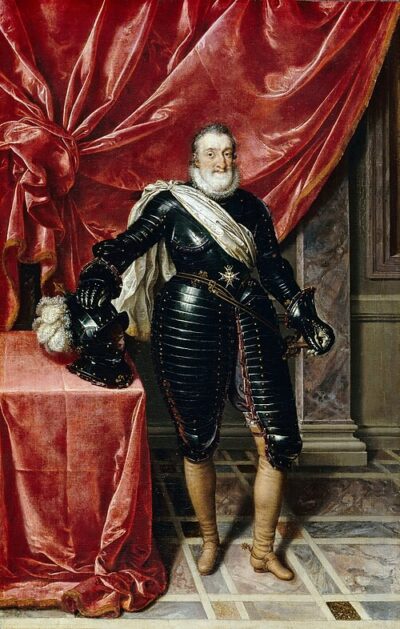
Henry IV of France
Henry IV of France was a King of Navarre from 1572 to 1610 and King of France from 1589 to 1610. Born December 13, 1553, in Château de Pau. Died May 14, 1610, in Paris. Positions held include King of France (1589–1610), Monarch of Lower Navarre (1572–1610) and count of Foix (1572–1589). Awards include Golden Rose, Knight of the Garter and Order of the Holy Spirit.
Facts
37 facts · 2 confirmed by two sources · 9 cited · 26 from one source
Where this comes from
Papalocal keeps its own record. It started from these sources; what each one said is kept here as it was copied, so a change on their side never changes this page by itself. Tap one to read its version.
What Wikidata says · copied November 16, 2026 · revision 2569839725
- Described as
- King of Navarre from 1572 to 1610 and King of France from 1589 to 1610 (1553-1610)
- Other names
- Good King Henry, the Verdant Gallant, Le Vert Galant, Henri de Bourbon, Henry IV, Henry the Great
- Born
- December 13, 1553 · 4 references
- Died
- May 14, 1610 · 11 references
- Born in
- Château de Pau
- Died in
- Paris · 1 reference
- Buried in
- Basilica of Saint-Denis
- Cause of death
- stab wound
- Citizen of
- Kingdom of France
- Occupation
- politician; monarch; military commander
- Positions held
- King of France (1589–1610); Monarch of Lower Navarre (1572–1610); count of Foix (1572–1589); French co-prince of Andorra (1572–1610)
- Awards
- Golden Rose; Knight of the Garter (1590) · 1 reference; Order of the Holy Spirit · 1 reference; Order of Saint Michael · 1 reference; Order of Saints Maurice and Lazarus · 1 reference
- Spouse
- Margaret of Valois (1572–1599) · 4 references; Marie de' Medici (1600–1610) · 4 references
- Children
- Louis XIII of France · 1 reference; Elisabeth of France · 1 reference; Christine of France; Gaston, Duke of Orléans; Henrietta Maria of France · 1 reference; César, Duke of Vendôme; Catherine Henriette de Bourbon; Nicolas Henri, Duke of Orléans; Alexandre de Vendôme; Henri de Bourbon, Duke of Verneuil; Antoine de Bourbon; Jeanne-Baptiste de Bourbon · 1 reference
- Father
- Antoine of Navarre · 2 references
- Mother
- Jeanne d'Albret · 2 references
- Siblings
- Catherine de Bourbon
- Religion
- Catholic Church
- Wikipedias with a page
- 105
Wikidata item Q936976 (wikidata.org/wiki/Q936976), public domain (CC0). Copied November 16, 2026.
What Wikipedia says · copied November 16, 2026 · revision 1383742669
Henry IV (French: Henri IV; 13 December 1553 – 14 May 1610), also known by the epithets Good King Henry (le Bon Roi Henri) or Henry the Great (Henri le Grand), was King of Navarre (as Henry III) from 1572 and King of France from 1589 to 1610. He was the first monarch of France from the House of Bourbon, a cadet branch of the Capetian dynasty. He pragmatically balanced the interests of the Catholic and Protestant parties in France, as well as among the European states. He was assassinated in Paris in 1610 by a Catholic zealot, and was succeeded by his son Louis XIII.
Henry was baptised a Catholic but raised as a Huguenot in the Protestant faith by his mother, Queen Jeanne III of Navarre. He inherited the throne of Navarre in 1572 on his mother's death. As a Huguenot, Henry was involved in the French Wars of Religion, barely escaping assassination in the St. Bartholomew's Day massacre. He later led Protestant forces against the French royal army. Henry inherited the throne of France in 1589 upon the death of Henry III, his distant cousin. Henry IV initially kept the Protestant faith (the only French king to do so) and had to fight against the Catholic League, which refused to accept a Protestant monarch. After four years of military stalemate, Henry converted to Catholicism, reportedly saying that "Paris is well worth a Mass". As a pragmatic politician (politique), he promulgated the Edict of Nantes (1598), which guaranteed religious liberties to Protestants, thereby effectively ending the French Wars of Religion.
An active ruler, Henry worked to regularize state finance, promote agriculture, and encourage education. He began the first successful French colonization of the Americas. He promoted trade and industry, and prioritized the construction of roads, bridges, and canals to facilitate communication within France and strengthen the country's cohesion. These efforts stimulated economic growth and improved living standards.
While the Edict of Nantes brought religious peace to France, some hardline Catholics and Huguenots remained dissatisfied, leading to occasional outbreaks of violence and conspiracies. Henry IV also faced resistance from certain noble factions who opposed his centralization policies, leading to political instability. His main foreign policy success was the Peace of Vervins in 1598, which made peace in the long-running conflict with Spain. He formed a strategic alliance with England. He also forged alliances with Protestant states, such as the Dutch Republic and several German states, to counter the Catholic powers. His policies contributed to the stability and prominence of France in European affairs.
- Born, in its opening lines
- December 13, 1553
- Died, in its opening lines
- May 14, 1610
From the Wikipedia article “Henry IV of France” (en.wikipedia.org/wiki/Henry_IV_of_France), by its contributors, under CC BY-SA 4.0 (creativecommons.org/licenses/by-sa/4.0/). Copied November 16, 2026; not changed.
Confirmed Two sources agree. Cited One source, and it names where it got it. One source One source, without a reference of its own. Sources disagree The sources disagree. We show the best-supported value and keep theirs below.
