
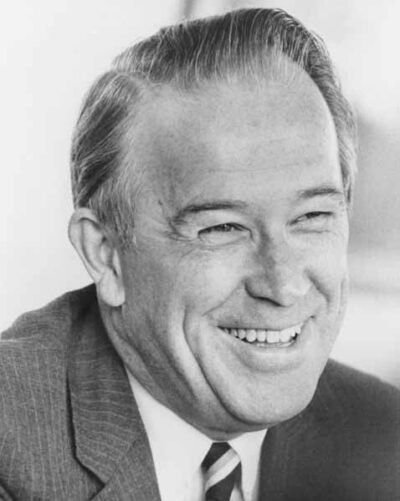
Henry M. Jackson
Henry M. Jackson was an American politician. Born May 31, 1912, in Everett. Died September 1, 1983, in Everett. Positions held include United States representative (1941–1953), prosecutor (1938–1940) and member (1946–). Educated at Stanford University and primary school. Awards include Presidential Medal of Freedom and John Muir Award.
Facts
23 facts · 2 confirmed by two sources · 10 cited · 11 from one source
Where this comes from
Papalocal keeps its own record. It started from these sources; what each one said is kept here as it was copied, so a change on their side never changes this page by itself. Tap one to read its version.
What Wikidata says · copied November 15, 2026 · revision 2569713645
- Described as
- American politician (1912–1983)
- Other names
- Henry Martin "Scoop" Jackson, Scoop Jackson, Henry Jackson, Henry Martin Jackson
- Born
- May 31, 1912 · 6 references
- Died
- September 1, 1983 · 6 references
- Born in
- Everett · 1 reference
- Died in
- Everett · 1 reference
- Buried in
- Evergreen Cemetery
- Cause of death
- aortic aneurysm
- Citizen of
- United States
- Occupation
- politician · 1 reference; lawyer (1935–) · 1 reference
- Positions held
- United States representative (1941–1953); prosecutor (1938–1940) · 1 reference; member (1946–) · 1 reference; chairperson (1960–) · 1 reference; United States senator (1953–1983) · 1 reference
- Political party
- Democratic Party
- Education
- Stanford University; primary school; University of Washington School of Law (–1935); Everett High School
- Member of
- Delta Chi
- Awards
- Presidential Medal of Freedom (1984) · 1 reference; John Muir Award (1969)
- Lived in
- Butler-Jackson House (1967–1983) · 1 reference
- Wikipedias with a page
- 26
Wikidata item Q1345201 (wikidata.org/wiki/Q1345201), public domain (CC0). Copied November 15, 2026.
What Wikipedia says · copied November 15, 2026 · revision 1384712871
Henry Martin "Scoop" Jackson (May 31, 1912 – September 1, 1983) was an American lawyer and politician who served as a U.S. representative (1941–1953) and U.S. senator (1953–1983) from the state of Washington. A Cold War liberal and anti-Communist member of the Democratic Party, Jackson supported higher military spending and a hard line against the Soviet Union, while also supporting social welfare programs, civil rights, and labor unions.
Born in Everett, Washington, to Norwegian immigrants, Jackson practiced law in Everett, after graduating from the University of Washington School of Law. He won election to Congress in 1940, and joined the Senate in 1953 after defeating incumbent Republican Party senator Harry P. Cain. Jackson supported the civil rights movement of the 1960s, and authored the National Environmental Policy Act, which helped establish the principle of publicly analyzing environmental impacts. He co-sponsored the Jackson–Vanik amendment, which denied normal trade relations to non-capitalist countries with restrictive emigration policies. Jackson served as chairman of the United States Senate Committee on Energy and Natural Resources from 1963 to 1981. He was twice an unsuccessful candidate for the Democratic Party nomination, in both the 1972 and 1976 presidential elections. While still serving in the Senate, Jackson died in 1983.
His political beliefs were characterized by support of civil rights, human rights, and safeguarding the environment, but with an equally strong commitment to oppose totalitarianism in general and – with the start of the Cold War — communist rule in particular. Jackson's political philosophies and positions have been cited as an influence on a number of key figures associated with neoconservatism, including Paul Wolfowitz and Richard Perle, both of whom previously served as aides to Jackson.
- Born, in its opening lines
- May 31, 1912
- Died, in its opening lines
- September 1, 1983
From the Wikipedia article “Henry M. Jackson” (en.wikipedia.org/wiki/Henry_M._Jackson), by its contributors, under CC BY-SA 4.0 (creativecommons.org/licenses/by-sa/4.0/). Copied November 15, 2026; not changed.
Confirmed Two sources agree. Cited One source, and it names where it got it. One source One source, without a reference of its own. Sources disagree The sources disagree. We show the best-supported value and keep theirs below.
