
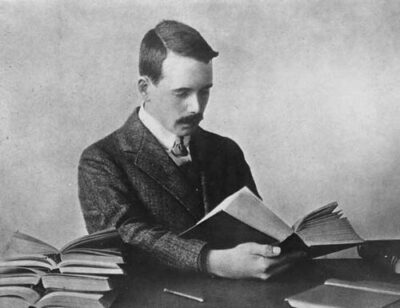
Henry Moseley
Henry Moseley was an English physicist. Born November 23, 1887, in Weymouth. Died August 10, 1915, in Gallipoli. Educated at Eton College and Trinity College. Awards include Matteucci Medal.
Facts
21 facts · 2 confirmed by two sources · 3 cited · 16 from one source
Where this comes from
Papalocal keeps its own record. It started from these sources; what each one said is kept here as it was copied, so a change on their side never changes this page by itself. Tap one to read its version.
What Wikidata says · copied November 16, 2026 · revision 2559335603
- Described as
- English physicist
- Other names
- Henry Gwyn Jeffreys Moseley
- Born
- November 23, 1887 · 4 references
- Died
- August 10, 1915 · 4 references
- Born in
- Weymouth
- Died in
- Gallipoli
- Cause of death
- gunshot wound
- Name at birth
- Henry Gwyn Jeffreys Moseley · 1 reference
- Citizen of
- United Kingdom of Great Britain and Ireland
- Occupation
- physicist · 1 reference; engineer; chemist
- Worked for
- University of Manchester; University of Oxford
- Education
- Eton College; Trinity College; Summer Fields School; University of Oxford · 1 reference
- Member of
- Manchester Literary and Philosophical Society
- Awards
- Matteucci Medal (2010)
- Field
- nuclear physics; physics · 1 reference
- Father
- Henry Nottidge Moseley
- Wikipedias with a page
- 55
Wikidata item Q310759 (wikidata.org/wiki/Q310759), public domain (CC0). Copied November 16, 2026.
What Wikipedia says · copied November 16, 2026 · revision 1385277846
Henry Gwyn Jeffreys Moseley (; 23 November 1887 – 10 August 1915) was an English physicist, whose contribution to the science of physics was the justification from physical laws of the previous empirical and chemical concept of the atomic number. This stemmed from his development of Moseley's law in X-ray spectra.
Moseley's law advanced atomic physics, nuclear physics and quantum physics by providing the first experimental evidence in favour of Niels Bohr's theory, aside from the hydrogen atom spectrum which the Bohr theory was designed to reproduce. That theory refined Ernest Rutherford's and Antonius van den Broek's model, which proposed that the atom contains in its nucleus a number of positive nuclear charges that is equal to its (atomic) number in the periodic table.
When World War I broke out in Western Europe, Moseley left his research work at the University of Oxford behind to volunteer for the Royal Engineers of the British Army. Moseley was assigned to the force of British Empire soldiers that invaded the region of Gallipoli, Turkey, in April 1915, as a telecommunications officer. Moseley was shot and killed during the Battle of Gallipoli on 10 August 1915, at the age of 27. Experts have speculated that Moseley could otherwise have been awarded the Nobel Prize in Physics in 1916.
- Born, in its opening lines
- November 23, 1887
- Died, in its opening lines
- August 10, 1915
From the Wikipedia article “Henry Moseley” (en.wikipedia.org/wiki/Henry_Moseley), by its contributors, under CC BY-SA 4.0 (creativecommons.org/licenses/by-sa/4.0/). Copied November 16, 2026; not changed.
Confirmed Two sources agree. Cited One source, and it names where it got it. One source One source, without a reference of its own. Sources disagree The sources disagree. We show the best-supported value and keep theirs below.
