
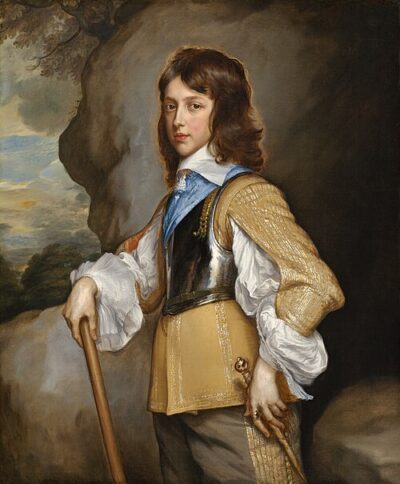
Henry Stuart, Duke of Gloucester
Henry Stuart, Duke of Gloucester was a son of Charles I of England. Born July 8, 1640, in Oatlands Palace. Died September 18, 1660, in Palace of Whitehall. Positions held include Duke of Gloucester (1659–1660). Awards include Order of the Garter.
Facts
19 facts · 1 confirmed by two sources · 7 cited · 10 from one source · 1 where the sources disagree
What’s different
- Died: we show September 18, 1660 (Sources disagree). Wikipedia says September 13, 1660
Where this comes from
Papalocal keeps its own record. It started from these sources; what each one said is kept here as it was copied, so a change on their side never changes this page by itself. Tap one to read its version.
What Wikidata says · copied November 18, 2026 · revision 2563636747
- Described as
- son of Charles I of England (1640-1660)
- Other names
- Henry of Oatlands, Henry Stuart, Henry, Duke of Gloucester (1640–1660)
- Born
- July 8, 1640 · 2 references
- Died
- September 18, 1660
- Born in
- Oatlands Palace
- Died in
- Palace of Whitehall
- Buried in
- Westminster Abbey
- Cause of death
- smallpox
- Citizen of
- Kingdom of England
- Occupation
- aristocrat
- Positions held
- Duke of Gloucester (1659–1660) · 1 reference
- Awards
- Order of the Garter
- Father
- Charles I of England · 1 reference
- Mother
- Henrietta Maria of France · 1 reference
- Siblings
- Henrietta of England · 1 reference; Mary Henrietta, Princess Royal · 1 reference; Princess Anne of England; Princess Elizabeth of England; James II of England · 1 reference; Charles II of England · 1 reference
- Religion
- Anglicanism
- Wikipedias with a page
- 22
Wikidata item Q2561668 (wikidata.org/wiki/Q2561668), public domain (CC0). Copied November 18, 2026.
What Wikipedia says · copied November 18, 2026 · revision 1358682240
Henry Stuart, Duke of Gloucester (8 July 1640 – 13 September 1660) was the youngest son of Charles I, King of England, Scotland, and Ireland, and Henrietta Maria of France. He is also known as Henry of Oatlands.
From the age of two, Henry and his sister Elizabeth were separated from their family during the English Civil War and became prisoners of Parliament. For several years, the children were constantly transported from one residence to another due to the plague raging in London. They also periodically changed their governesses and guardians to those more loyal to the government. In 1645, Henry and Elizabeth were joined by their elder brother James, Duke of York, who found himself in a difficult financial situation. In 1647, Charles I was arrested and during the years 1647–1648, he was allowed to see his children several times. In April 1648, James fled the country; it was probably planned that he would take Henry with him, but Elizabeth was afraid to let her younger brother go. When in 1649 Charles I was sentenced to death, he, fearing that Henry would be proclaimed king and made a puppet of the government, took an oath from his 8-year-old son not to take the crown for anything while both of his older brothers were alive.
After the execution of Charles I, Scotland proclaimed his eldest son Charles II as their sovereign. In the summer of 1650, he landed in Scotland, which prompted Parliament to send the children of the late monarch to Carisbrooke Castle on the Isle of Wight, where their father had previously been imprisoned. Before leaving for Carisbrooke, Henry and Elizabeth were stripped of all titles and privileges. Shortly after arriving on the Isle of Wight in September 1650, Henry's sister fell ill and died. Henry remained at Carisbrooke until the following year, when, with the permission of Oliver Cromwell, he returned to the continent, where he eventually joined his mother in Paris. With Henrietta Maria, whom the prince had not seen for eleven years, Henry did not have a good understanding: the prince was an ardent Protestant, and his mother was an implacable Catholic. The Queen, against the wishes of her late husband and eldest son, tried to convert Henry to Catholicism, but this only deteriorated their relationship. Henry went to his brother Charles in Cologne. In 1657, the prince fought on the side of the Spanish against France with his brother James. In May 1659, Charles restored to his brother the title of Duke of Gloucester, which Henry had been deprived of by Parliament in 1650, and bestowed the title of Earl of Cambridge.
After the restoration of the monarchy in England in 1660, Henry accompanied his brother during his return to Britain. There Henry received a number of appointments, but before the coronation of Charles II, he contracted smallpox and died. He was buried in the vault of Mary, Queen of Scots in Westminster Abbey, where his elder sister Mary, who also died of smallpox, was buried a few weeks later.
- Born, in its opening lines
- July 8, 1640
- Died, in its opening lines
- September 13, 1660
From the Wikipedia article “Henry Stuart, Duke of Gloucester” (en.wikipedia.org/wiki/Henry_Stuart,_Duke_of_Gloucester), by its contributors, under CC BY-SA 4.0 (creativecommons.org/licenses/by-sa/4.0/). Copied November 18, 2026; not changed.
Confirmed Two sources agree. Cited One source, and it names where it got it. One source One source, without a reference of its own. Sources disagree The sources disagree. We show the best-supported value and keep theirs below.
