
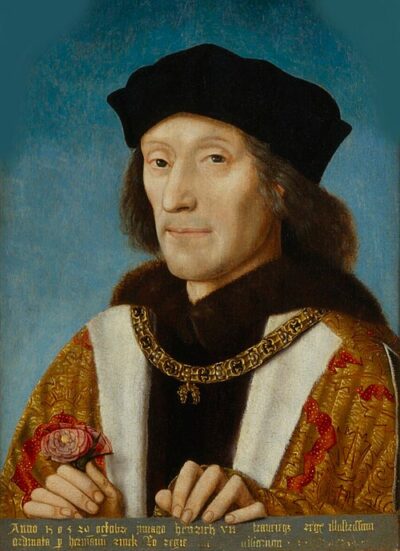
Henry VII of England
Henry VII of England was a King of England from 1485 to 1509. Born January 28, 1457, in Pembroke Castle. Died April 21, 1509, in Richmond Palace. Positions held include Monarch of England (1485–1509) and Lord of Ireland (1485–1509). Awards include Knight of the Order of the Golden Fleece.
Facts
26 facts · 2 confirmed by two sources · 12 cited · 12 from one source
Where this comes from
Papalocal keeps its own record. It started from these sources; what each one said is kept here as it was copied, so a change on their side never changes this page by itself. Tap one to read its version.
What Wikidata says · copied November 16, 2026 · revision 2569840700
- Described as
- King of England from 1485 to 1509
- Other names
- Solomon of England, Henry Tudor, Henry, 14th earl of Richmond
- Born
- January 28, 1457 · 4 references
- Died
- April 21, 1509 · 4 references
- Born in
- Pembroke Castle · 1 reference
- Died in
- Richmond Palace
- Buried in
- Westminster Abbey
- Cause of death
- tuberculosis
- Citizen of
- Kingdom of England; Principality of Wales
- Occupation
- monarch; royalty · 1 reference
- Positions held
- Monarch of England (1485–1509); Lord of Ireland (1485–1509)
- Awards
- Knight of the Order of the Golden Fleece
- Spouse
- Elizabeth of York (1486–1503) · 2 references
- Children
- Arthur, Prince of Wales · 1 reference; Margaret Tudor · 1 reference; Henry VIII of England · 1 reference; Elizabeth Tudor; Mary Tudor · 1 reference; Edmund Tudor, Duke of Somerset; Edward Tudor · 1 reference; Katherine Tudor · 1 reference; Roland de Velville · 1 reference
- Father
- Edmund Tudor, 1st Earl of Richmond · 1 reference
- Mother
- Margaret Beaufort · 1 reference
- Religion
- Catholic Church
- Wikipedias with a page
- 85
Wikidata item Q675493 (wikidata.org/wiki/Q675493), public domain (CC0). Copied November 16, 2026.
What Wikipedia says · copied November 16, 2026 · revision 1384834221
Henry VII (28 January 1457 – 21 April 1509), also known as Henry Tudor, was King of England and Lord of Ireland from his seizure of the crown on 22 August 1485 until his death in 1509. He was the first monarch of the House of Tudor.
Henry was the son of Edmund Tudor, 1st Earl of Richmond, and Lady Margaret Beaufort, a great-granddaughter of John of Gaunt (son of Edward III) who founded the Lancastrian cadet branch of the House of Plantagenet. Thus Henry's claim to the English throne was as the great-great-great-grandson of Edward III.
Henry VII's father Edmund Tudor was the half-brother of the Lancastrian king Henry VI. Edmund died three months before his son was born, and Henry was raised by his uncle Jasper Tudor, a Lancastrian, and William Herbert, a supporter of the Yorkist branch of the House of Plantagenet. During Henry's early years, his uncles and the Lancastrians fought a series of civil wars against the Yorkist claimant, Edward IV. After Edward retook the throne in 1471, Henry spent 14 years in exile in Brittany. He attained the throne when his forces, supported by France and Scotland, defeated Richard III at the Battle of Bosworth Field. He was the last king of England to win his throne on the field of battle, defending it two years later at the Battle of Stoke Field to decisively end the Wars of the Roses (1455–1487). He strengthened his claim by marrying Elizabeth of York, Edward IV's daughter.
Henry restored power and stability to the English monarchy following the civil war. He is credited with many administrative, economic and diplomatic initiatives. His supportive policy toward England's wool industry and his standoff with the Low Countries had long-lasting benefits to the English economy. He paid very close attention to detail, and instead of spending lavishly, he concentrated on raising new revenues. He stabilised the government's finances by introducing several new taxes. After his death, a commission found widespread abuses in the tax collection process. Henry reigned for nearly 24 years and was peacefully succeeded by his son, Henry VIII.
- Born, in its opening lines
- January 28, 1457
- Died, in its opening lines
- April 21, 1509
From the Wikipedia article “Henry VII of England” (en.wikipedia.org/wiki/Henry_VII_of_England), by its contributors, under CC BY-SA 4.0 (creativecommons.org/licenses/by-sa/4.0/). Copied November 16, 2026; not changed.
Confirmed Two sources agree. Cited One source, and it names where it got it. One source One source, without a reference of its own. Sources disagree The sources disagree. We show the best-supported value and keep theirs below.
