
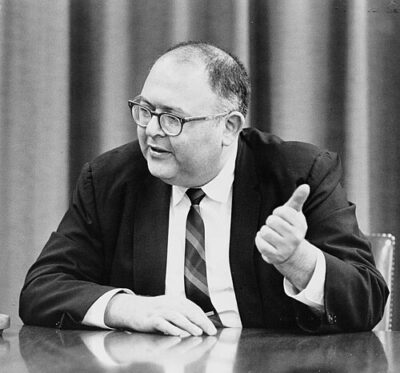
Herman Kahn
Herman Kahn was an American futurist noted for his views on nature of thermonuclear war. Born February 15, 1922, in Bayonne. Died July 7, 1983, in Chappaqua. Positions held include co-founder (1961–). Known for The Next 200 Years: A Scenario for America and the World. Educated at California Institute of Technology and University of California, Los Angeles.
Facts
16 facts · 2 confirmed by two sources · 4 cited · 10 from one source
Where this comes from
Papalocal keeps its own record. It started from these sources; what each one said is kept here as it was copied, so a change on their side never changes this page by itself. Tap one to read its version.
What Wikidata says · copied November 15, 2026 · revision 2554552203
- Described as
- American futurist noted for his views on nature of thermonuclear war (1922–1983)
- Born
- February 15, 1922 · 7 references
- Died
- July 7, 1983 · 8 references
- Born in
- Bayonne
- Died in
- Chappaqua
- Buried in
- Fair Ridge Cemetery · 1 reference
- Cause of death
- myocardial infarction
- Citizen of
- United States
- Occupation
- mathematician · 1 reference; futurist · 1 reference; lobbyist · 1 reference
- Positions held
- co-founder (1961–)
- Worked for
- RAND Corporation
- Education
- California Institute of Technology; University of California, Los Angeles
- Known for
- The Next 200 Years: A Scenario for America and the World
- Religion
- atheism
- Wikipedias with a page
- 30
Wikidata item Q267605 (wikidata.org/wiki/Q267605), public domain (CC0). Copied November 15, 2026.
What Wikipedia says · copied November 15, 2026 · revision 1384325115
Herman Kahn (February 15, 1922 – July 7, 1983) was an American physicist and a founding member of the Hudson Institute, regarded as an eminent futurist of the latter part of the twentieth century.
He originally came to prominence as a military strategist and systems theorist while employed at the RAND Corporation. There, he analyzed the likely consequences of nuclear war and recommended ways to improve survivability during the Cold War. Kahn posited the idea of a "winnable" nuclear exchange in his 1960 book On Thermonuclear War, for which he was one of the historical inspirations for the eponymous character of Stanley Kubrick's classic black comedy film satire Dr. Strangelove. In his commentary for Fail Safe, director Sidney Lumet remarked that the Professor Groeteschele character is also based on Herman Kahn.
Kahn's theories contributed to the development of the nuclear strategy of the United States.
- Born, in its opening lines
- February 15, 1922
- Died, in its opening lines
- July 7, 1983
From the Wikipedia article “Herman Kahn” (en.wikipedia.org/wiki/Herman_Kahn), by its contributors, under CC BY-SA 4.0 (creativecommons.org/licenses/by-sa/4.0/). Copied November 15, 2026; not changed.
Confirmed Two sources agree. Cited One source, and it names where it got it. One source One source, without a reference of its own. Sources disagree The sources disagree. We show the best-supported value and keep theirs below.
