
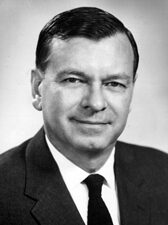
Herman Talmadge
Herman Talmadge was an American politician. Born August 9, 1913, in McRae. Died March 21, 2002, in Hampton. Positions held include United States senator (1957–1981), Governor of Georgia (1947–1955) and senator. Educated at University of Georgia and Druid Hills High School.
Facts
19 facts · 2 confirmed by two sources · 8 cited · 9 from one source
Where this comes from
Papalocal keeps its own record. It started from these sources; what each one said is kept here as it was copied, so a change on their side never changes this page by itself. Tap one to read its version.
What Wikidata says · copied November 18, 2026 · revision 2565423141
- Described as
- American politician (1913–2002)
- Other names
- Herman Eugene Talmadge, Herman E. Talmadge
- Born
- August 9, 1913 · 2 references
- Died
- March 21, 2002 · 3 references
- Born in
- McRae
- Died in
- Hampton
- Buried in
- Georgia · 1 reference
- Citizen of
- United States
- Occupation
- politician · 1 reference; governor · 1 reference; jurist · 1 reference
- Positions held
- United States senator (1957–1981) · 1 reference; Governor of Georgia (1947–1955) · 1 reference; senator · 1 reference
- Political party
- Democratic Party
- Education
- University of Georgia; Druid Hills High School · 1 reference; University of Georgia School of Law
- Spouse
- Betty Talmadge · 1 reference
- Father
- Eugene Talmadge · 1 reference
- Lived in
- Crawford-Talmadge House · 1 reference
- Wikipedias with a page
- 17
Wikidata item Q356029 (wikidata.org/wiki/Q356029), public domain (CC0). Copied November 18, 2026.
What Wikipedia says · copied November 18, 2026 · revision 1385403246
Herman Eugene Talmadge (August 9, 1913 – March 21, 2002) was an American politician who served as governor of Georgia from 1948 to 1955 (following an unsuccessful claim in 1947) and as a U.S. senator from Georgia from 1957 to 1981. A Democrat, Talmadge served during a time of political transition, both in Georgia and nationally. He began his career as a staunch segregationist known for his opposition to civil rights, including supporting legislation that would have closed public schools to prevent desegregation. By the later stages of his career, Talmadge, like many other Southern politicians of the period, had modified his views on race following the enactment of the Voting Rights Act. The act increased African American voter participation and gave substance to the Fifteenth Amendment, enacted nearly a century earlier. His life eventually encapsulated the emergence of his native Georgia from entrenched white supremacy into a multiracial political culture where many white voters regularly elect Black and other non-white candidates to the U.S. Congress and Georgia General Assembly.
When his father, Eugene Talmadge, won the 1946 Georgia gubernatorial election but died before taking office, Herman Talmadge asserted claims to be the 70th governor of Georgia, in what became known as the three governors controversy. In 1947 the General Assembly held a special election to choose between the second- and third-placed candidates in case of his death, and thus prepared by organizing enough write-in votes to ensure his son Herman Talmadge would take part. He lost the election but then produced enough write in votes that he discovered at his house that insured his governorship. He occupied the governor's office from January until March until it was revealed that the write in votes were fraudulent. In fact not only were there names of deceased individuals but their names were also in alphabetical order. Thus the Georgia Supreme Court stripped him of his governorship and decided in favor of Lieutenant Governor-elect Melvin E. Thompson since he was already the acting Lieutenant Governor. The state constitution in effect at the time then required a special election to be held simultaneously with the next state legislative election to fill the remainder of the term. Talmadge defeated Thompson November 2, 1948 by about six percent in
that special election to complete the elder Talmadge's unfinished four-year term. He was reelected in 1950, defeating Thompson by a narrower margin. Talmadge served until the end of his term in 1955.
Talmadge, who first became governor at age 33, supported a new statewide sales tax during his second term to fund the construction of new schools and expanded state services. He also supported other infrastructure improvements and increased teachers' salaries. In so doing, the younger governor Talmadge departed from his father's stingy, low-tax and low-spending philosophy while remaining steadfastly opposed to racial desegregation and political equality for Black Americans. He left the governor's office as an incredibly popular executive whose administration earned praise from the traditionally liberal outlets such as the Atlanta Constitution and even Harper's Magazine.
Herman Talmadge was elected to the United States Senate in 1956 when Walter F. George, Georgia's senior senator and the President pro tempore of the United States Senate, declined to seek reelection. In the Senate, Talmadge was a long-serving member of the Senate Agriculture Committee as well as the Senate Finance Committee. During the latter part of his career, he also served as a member of the Select Committee on Presidential Campaign Activities (better known as the Senate Watergate Committee). As chairman of the Senate Agriculture Committee, he oversaw the passage of numerous pieces of important legislation, including the expansion of the Child Nutrition Act and the Consolidated Farm and Rural Development Act of 1972, the first major legislation dealing with rural development since the Rural Electrification Act of 1936. The Senate later denounced Talmadge for financial irregularities that were revealed during a Senate Ethics Committee investigation following a contentious divorce from his second wife. The investigation, as well as Georgia's changing demographics, helped Republican Mack Mattingly defeat Talmadge for re-election in 1980. Following his defeat, Talmadge retired from public life.
- Born, in its opening lines
- August 9, 1913
- Died, in its opening lines
- March 21, 2002
From the Wikipedia article “Herman Talmadge” (en.wikipedia.org/wiki/Herman_Talmadge), by its contributors, under CC BY-SA 4.0 (creativecommons.org/licenses/by-sa/4.0/). Copied November 18, 2026; not changed.
Confirmed Two sources agree. Cited One source, and it names where it got it. One source One source, without a reference of its own. Sources disagree The sources disagree. We show the best-supported value and keep theirs below.
