
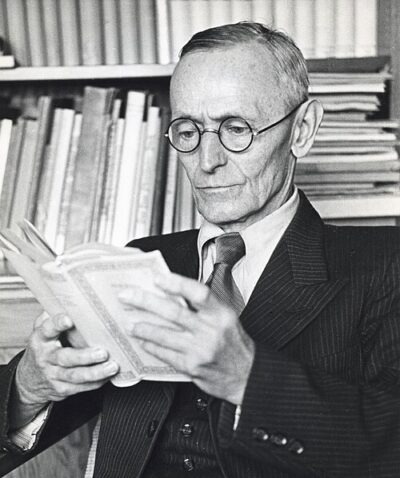
Hermann Hesse
Hermann Hesse was a Nobel Prize winning German-Swiss poet, novelist and painter. Born July 2, 1877, in Calw. Died August 9, 1962, in Montagnola. Known for The Glass Bead Game, Demian and Steppenwolf. Educated at Johannes-Kepler-Gymnasium and Evangelical Seminaries of Maulbronn and Blaubeuren. Awards include Nobel Prize in Literature, Pour le Mérite for Sciences and Arts order and Bauernfeld prize.
Facts
47 facts · 2 confirmed by two sources · 23 cited · 22 from one source
Where this comes from
Papalocal keeps its own record. It started from these sources; what each one said is kept here as it was copied, so a change on their side never changes this page by itself. Tap one to read its version.
What Wikidata says · copied November 16, 2026 · revision 2566064803
- Described as
- Nobel Prize winning German-Swiss poet, novelist and painter (1877–1962)
- Other names
- Hermann Karl Hesse, Hh. Hesse, Herman Hesse
- Born
- July 2, 1877 · 22 references
- Died
- August 9, 1962 · 21 references
- Born in
- Calw · 3 references
- Died in
- Montagnola · 4 references
- Buried in
- Sant'Abbondio Cemetery in Gentilino · 1 reference
- Cause of death
- stroke
- Name at birth
- Hermann Karl Hesse
- Citizen of
- German Empire (1890–); Switzerland (1924–) · 3 references; Germany · 2 references
- Occupation
- novelist; poet · 4 references; literary scholar; painter · 4 references; philosopher · 1 reference; resistance fighter; illustrator · 1 reference; writer · 5 references
- Education
- Johannes-Kepler-Gymnasium; Evangelical Seminaries of Maulbronn and Blaubeuren
- Member of
- Prussian Academy of Arts (1926–1930) · 1 reference
- Known for
- The Glass Bead Game; Demian; Steppenwolf; Siddhartha; Peter Camenzind; Narcissus and Goldmund
- Awards
- Nobel Prize in Literature (1946) · 2 references; Pour le Mérite for Sciences and Arts order; Bauernfeld prize (1905); Peace Prize of the German Publishers' and Booksellers' Association (1955) · 1 reference; Gottfried-Keller-Preis (1936); Goethe Prize of the City of Frankfurt (1946); Wilhelm Raabe Prize (1950) · 1 reference; Pour le Mérite · 1 reference
- Field
- prose · 1 reference
- Spouse
- Ruth Wenger (1924–1927) · 1 reference; Ninon Hesse (1931–1962) · 1 reference; Mia Hesse-Bernoulli · 1 reference
- Children
- Bruno Hesse · 1 reference; Martin Hesse · 1 reference; Heiner Hesse
- Father
- Johannes Hesse · 1 reference
- Mother
- Marie Hesse · 1 reference
- Siblings
- Marulla Hesse; Hans Hesse · 1 reference
- Religion
- reformed · 1 reference
- Wikipedias with a page
- 164
Wikidata item Q25973 (wikidata.org/wiki/Q25973), public domain (CC0). Copied November 16, 2026.
What Wikipedia says · copied November 16, 2026 · revision 1384876182
Hermann Karl Hesse (German: [ˈhɛʁman ˈhɛsə] ; 2 July 1877 – 9 August 1962) was a German-Swiss poet and novelist, and winner of the 1946 Nobel Prize in Literature. His interest in Eastern religious, spiritual, and philosophical traditions, combined with his involvement with Jungian analysis, helped shape his literary work. His best-known novels include Demian, Steppenwolf, Siddhartha, Narcissus and Goldmund, and The Glass Bead Game, each of which explores an individual's search for authenticity, self-knowledge, and spirituality.
Hesse was a widely-read author in German-speaking countries during his lifetime, but his more enduring international fame did not come until a few years after his death, when, in the mid-1960s, his works became enormously popular with post-World War II generation readers in the United States, Europe, and elsewhere.
- Born, in its opening lines
- July 2, 1877
- Died, in its opening lines
- August 9, 1962
From the Wikipedia article “Hermann Hesse” (en.wikipedia.org/wiki/Hermann_Hesse), by its contributors, under CC BY-SA 4.0 (creativecommons.org/licenses/by-sa/4.0/). Copied November 16, 2026; not changed.
Confirmed Two sources agree. Cited One source, and it names where it got it. One source One source, without a reference of its own. Sources disagree The sources disagree. We show the best-supported value and keep theirs below.
