
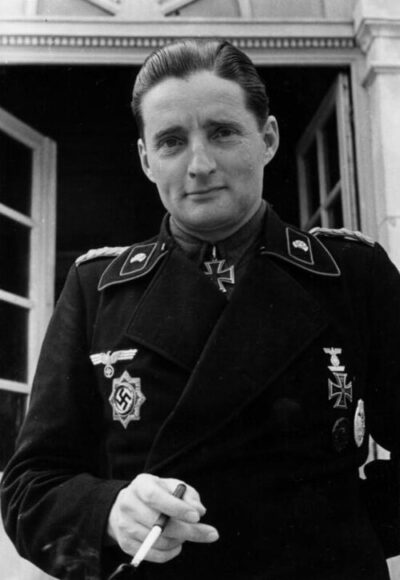
Hermann von Oppeln-Bronikowski
Hermann von Oppeln-Bronikowski was a German general. Born January 2, 1899, in Berlin. Died September 19, 1966, in Gaißach. Awards include German Cross in Gold, Knight's Cross of the Iron Cross with Oak Leaves and Swords and Clasp to the Iron Cross.
Facts
20 facts · 2 confirmed by two sources · 4 cited · 14 from one source
Where this comes from
Papalocal keeps its own record. It started from these sources; what each one said is kept here as it was copied, so a change on their side never changes this page by itself. Tap one to read its version.
What Wikidata says · copied November 18, 2026 · revision 2568914821
- Described as
- German general (1899-1966)
- Other names
- Hermann Leopold August von Oppeln-Bronikowski
- Born
- January 2, 1899
- Died
- September 19, 1966
- Born in
- Berlin · 1 reference
- Died in
- Gaißach · 1 reference
- Citizen of
- Germany
- Occupation
- dressage rider; military officer; major general · 1 reference; equestrian · 1 reference
- Sport
- equestrian sport
- Awards
- German Cross in Gold; Knight's Cross of the Iron Cross with Oak Leaves and Swords; Clasp to the Iron Cross · 1 reference; German Cross · 1 reference; Panzer Badge · 1 reference
- Field
- general
- Father
- Hermann von Oppeln-Bronikowski
- Military branch
- Imperial German Army · 1 reference
- Military rank
- Generalmajor; major general · 1 reference
- Wikipedias with a page
- 22
Wikidata item Q63852 (wikidata.org/wiki/Q63852), public domain (CC0). Copied November 18, 2026.
What Wikipedia says · copied November 18, 2026 · revision 1380059668
Hermann Leopold August von Oppeln-Bronikowski (2 January 1899 – 19 September 1966) was an Olympic equestrian, winning a gold medal in the team dressage at the 1936 Olympics. He later served as a panzer general during World War II.
As a lieutenant during World War I, he was awarded the Iron Cross in 1918.
During World War II, he served with distinction in Poland in 1939 and then on the Russian Front, commanding several tanks that were knocked out and personally leading several ad hoc attacks.
Oppeln-Bronikowski led the desperate attack of the 22nd Panzer Division on 19 November 1942 in an attempt to forestall the encirclement of German forces in Stalingrad.
He was considered an excellent panzer commander, but had problems with higher authority as he was an excessive drinker. In one particular instance, as an Oberst commanding the 100th Panzer Division at Falaise, France; he was visited at 8:15 in the morning on 11 May 1944 by Rommel, who was satisfied with the forces' defensive preparations, but said to him – You lazy stinkers, what happens if the enemy invasion begins before 8:30! Oppeln-Bronikowski, who had gone to sleep in his now crumpled and tobacco-smelling uniform, and still had alcohol on his breath, could only reply Catastrophe and Rommel laughed. Oppeln-Bronikowski led a panzer counter-attack on the invading forces immediately after the D-Day Invasion, and was told by his commanding officer that if he did not throw the British back into the sea, the war would be lost. Some of his tanks managed to reach the coast, but were soon forced to withdraw, with the counter-attack subsequently failing. D-Day was the major turning point of the war on the Western front.
He commanded the 20th Panzer Division and was awarded the Knight's Cross of the Iron Cross with Oak Leaves and Swords.
He was among Cornelius Ryan's interviewees when Ryan was preparing The Longest Day.
He died of a heart attack in 1966.
- Born, in its opening lines
- January 2, 1899
- Died, in its opening lines
- September 19, 1966
From the Wikipedia article “Hermann von Oppeln-Bronikowski” (en.wikipedia.org/wiki/Hermann_von_Oppeln-Bronikowski), by its contributors, under CC BY-SA 4.0 (creativecommons.org/licenses/by-sa/4.0/). Copied November 18, 2026; not changed.
Confirmed Two sources agree. Cited One source, and it names where it got it. One source One source, without a reference of its own. Sources disagree The sources disagree. We show the best-supported value and keep theirs below.
